I’m retiring in January. I’ve managed (and that word suggests more of a conscious process than it should!) my academic career without a single day of unemployment. But this doesn’t mean it’s all been a bed of roses, and I’m writing this to share my experiences of uncertainty and to tell people how it was in my past, and how I coped, from starting my PhD in 1980. While some things were easier, getting a permanent job in academia wasn’t one of them.
How PhDs worked…
Doing a PhD wasn’t inevitable! Actually, neither was going to university; I’d worked in a bookshop for a year after leaving school, as I wasn’t sure university was for me. I never intended to do a PhD – I didn’t know what one was, or what it involved. I went straight from a combined honours BA in Ancient History/Social Anthropology at UCL to PhD work there, simply because further study had started to appeal, and because I got the funding from the Department for Education. There was no interview: I assume funding was allocated by degree result and references. I’d only had to write about 15 lines on my topic, ‘Ancient Greek concepts of time’, in contrast to today where it seems you need to have pretty well written the PhD thesis in order to persuade anyone to fund you. I’d have been stretched writing more than 15 lines!
Hurdle no.1 safely over, I had six months of not having a clue what I was supposed to be doing. I hadn’t written a dissertation as part of my BA, and here I was contemplating 100,000 words on… well, something. The MA as PhD preparation didn’t yet exist. I eventually got stuck into an analysis of Hesiod’s myth of the 5 ages/races, went along to seminars at the ICS, and started to realise I was interested in ‘time’ in the sense of the female life cycle. I had just one supervisor, Sally Humphreys, chosen because she had started up the combined honours degree I had taken, and therefore knew where I was coming from. I worked with her on editorial work for Mortality and Immortality: The Anthropology and Archaeology of Death (1981) which taught me something about academic writing. There were no skills seminars for postgrads. Essentially, I felt lost all the time.
Sally felt I needed a change of scene and persuaded the funders to let me go to France for 5 months to sit at the feet of the Paris structuralists. I had a great time (how long have you got??) at seminars and lectures and going to the cinema and at the end of it felt sufficiently guilty about the lack of any real research to offer a paper to a new series the ICS was about to put on. This made me buckle down to serious work on my return. I sent the resulting paper, ‘Bound to bleed’, to the Journal of Hellenic Studies, which rejected it in a not particularly sensitive manner, but then the paper was solicited for the collection Images of Women in Antiquity. Not only in Paris, but in the UK I attended lots of conferences, started to network, and found people who would become my referees. At conferences, Sally would always prod me and insist ‘Ask a question!!’ She was right: I began to become visible.
And then??
‘B2B’ came out in 1983: hurdle no.2, a publication (a very short one). Even before it appeared in print, as my sole output it became my ‘research fellowship piece’ when, encouraged by Sally, I did the rounds of the Oxford and Cambridge JRFs. Most people were submitting as their ‘piece’ a draft of their thesis! Supported by a reference from Geoffrey Lloyd, to whom Sally had introduced me, and by supportive UCL staff, I had many interviews and many rejections. I was often the only woman being interviewed, usually the only person not to come from Oxbridge, and certainly the only person working on bodily fluids. It was dispiriting in the extreme. Because what was being tested wasn’t just your work, but your fit with the college, rejection extended further into the psyche than it normally does. And then Newnham offered me a JRF… Hurdle no.3 safely overcome.
Looking for jobs
I still didn’t feel that an academic career was inevitable. I didn’t finish the PhD thesis until a year or more into the JRF. I gained teaching experience giving occasional lectures on other people’s courses. I did more research. But there were no ‘proper jobs’. I remember sitting down at a conference with a fellow London PhD graduate, analysing the pedigrees of nearly all those with permanent Classics jobs in the UK. All from Oxbridge: we seemed to have no chance at all, but in any case the market was stagnant. In some desperation, as my three JRF years drew to a close, I tried and failed with the Civil Service and the prison service, while applying for more research fellowships, in the US, Rome and Newcastle.
Helen at her PhD graduation
I thought the Newcastle interview went well but I heard nothing from them. Meanwhile I was offered one-year fellowships in the US and in Rome. But one year isn’t very long, and Newcastle was a two-year post, so after a week of waiting I phoned Newcastle and they were surprised I hadn’t received the letter offering me the post… Yes, that does happen.
I don’t count Newcastle as hurdle no.4, because in an important way it made me even less employable. The terms of the fellowship meant I could only give about one lecture a year, and I did no marking or examining. While at Newcastle, I applied for every Classics job going, and some Anthropology jobs, with depressing results. Interviewers would ask ‘Wouldn’t you be happier in a research institute?’ I wanted to shout no, no, a thousand times no: I want to have a proper job like you’ve got! One of the jobs I went for was at Liverpool Institute of Higher Education: the job spec was to teach Roman Britain, in a History department. I had never studied Roman Britain, had hardly ever taught anything, and all the others being interviewed were archaeologists specialising in it. So, no chance. But I got the job. Why? Partly because it was a Church foundation and I was on the Church of England’s General Synod at the time – some on the panel thought I would be useful if their funding climate got tough. Partly because the HoD wanted to expand the ancient side of things, so I soon found myself teaching Greek history, Roman republic, Roman Empire, religion and women. You never know what is going on behind the scenes of the department to which you apply.
Jobs
Liverpool was where I learned to teach, thus meaning I’d crossed hurdle no.4. Many colleagues were from school-teaching backgrounds and around half our students were on the B.Ed programme. The library was full of books on how to teach and, as in a school, staff took breaks at the same time and could share ideas and information. 30% of the students were mature, which was challenging and enjoyable, as they were really enthusiastic about the chance they’d been given to study history. In that first year I was barely one lecture ahead of my students, preparing lectures every night. I was also a resident tutor, which meant gaining experience of pastoral care, often at 3 a.m.
After 8 years at LIHE, a change of senior management gave a sense of vulnerability to an ancient historian, and I began looking around. The Wellcome Trust was starting its University Awards: five years of gradually reducing funding from the Trust with the host university putting in more and then guaranteeing a proper job at the end. I approached one university, which didn’t want me. I then tried Reading, where the then-Head of History could see the scope for a joint appointment with Classics, factoring in probable retirements over the next five years, and he set up interviews and negotiated with the Trust. So I was back in the ‘university sector’ again. That meant becoming an employer rather than a candidate, and in 2007 I wrote some advice to job applicants from that point of view.
I moved from Reading to the OU for a range of reasons; not least of them, that the (excellent) Classics department were all put at risk of redundancy, in a cynical move about which I should probably say no more here. It doesn’t matter if you’re a professor, with a strong REF entry, and all the other things we’re supposed to have: the process of writing a 2-page document on ‘What I can offer Reading in the next 5 years’, as a way to save your job, gives you a strong urge to say ‘I can offer my resignation…’ Coincidentally, the OU advertised for a professor at the time I was writing this document. I’d applied to the OU maybe 20 years earlier (where haven’t I applied, over the decades?) and was turned down after interview. This time, I made it successfully through two days of interviews, to a job which I described then as ‘going as far as you can in UK HE without falling off the edge’.
Is it worse now?
What do I conclude from all this? That, yes, some things are worse now. You’re supposed to have pretty well written the PhD before you’re offered any funding to do it. You’re supposed to have the publications, the teaching experience, the big grant, the experience of outreach and the possible impact case, even before you have a proper job. And there are so many more people with PhDs, and the squeaky new PhD with a thesis that is likely to become a monograph within the next two years will always look attractive for the REF. But some things are better. One of the side effects of the grant culture, and of proper maternity leave (and more women in permanent jobs!) is that temporary posts are even more common, although the pattern of moving from one of these on to another, with completely different teaching to prepare each time, is demoralising and not conducive to research. The presence of more women in the academy means that it’s more common for the long-hours culture to be challenged and meetings to be held within the working day. I didn’t have children and didn’t marry until my forties, so I often worked on Saturdays: I don’t expect any of my colleagues to do this now.
Looking back, my advice would be to network. Attend conferences. Ask questions. Acquire possible referees, treat them well (no last-minute requests for a reference) and if you have any suspicions that they are just churning out the same generic reference rather than targeting it to the person spec, get new ones. Write the book: don’t get side-tracked by any other writing until you’ve done that (I ignored that advice – I couldn’t have got away with it today). Live with your imposter syndrome: most of us have it, and you just need to do what you do as well as you can. And, as I said at the WCC pedagogy event, make sure you do something else, whether it’s caring for a family, growing vegetables, helping in your community, devoting energy to your hobby – the inevitable disappointments and rejections hurt more if what is rejected is all that you are.
Finally, the best piece of advice I ever received, from a colleague at LIHE: ‘Be yourself – only more so.’
Missed the Classics and Feminist Pedagogy event? You can still take part by reading a Storify of tweets from the day, put together by Liz Gloyn.
Choose either the comprehensive collection of all the tweets from the day, including thoughts and reactions from participants and readers around the world, or a curated selection of tweets with suggestions for teaching practice and further reading.
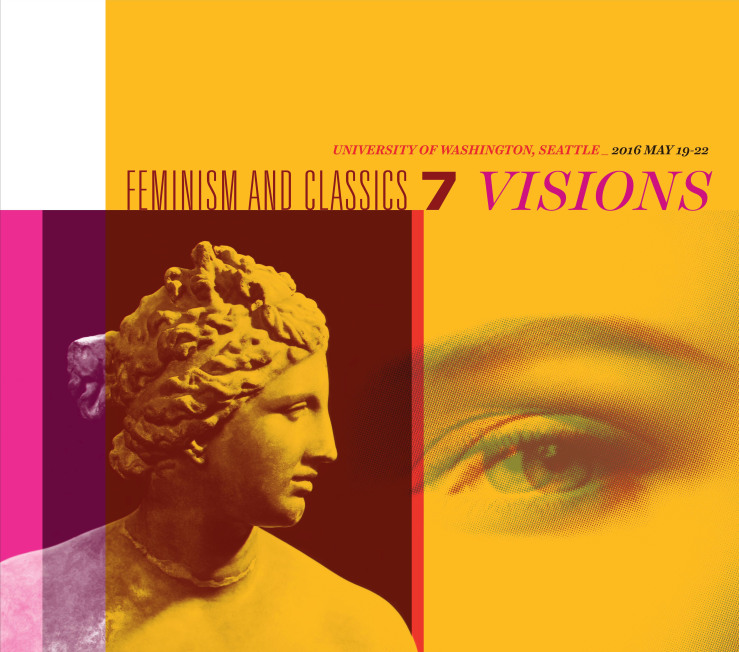
It’s great when a conference keynote sets the tone for the event as a whole. Alison Wylie (Washington) achieved this with her opening address to Feminism and Classics 7: Visions, held in Seattle in May. In exploring ‘What knowers know well: why feminism matters to archaeology’ she made a strong case for feminist approaches to gender archaeology and the study of early societies. From her perspective, non-feminist approaches were the ones that should be challenged, especially when they were importing assumptions about the domestic arrangements of early societies, as she demonstrated with textbook illustrations in which men were the focus and women domestic drudges in the background – one of many ways in which the conference theme would emerge in papers over the coming days. Combining humour, self-reflection and a combative stance, Alison Wylie exemplified a powerful mixture of knowledge and practice, leaving a large audience of conference attendees and the wider Seattle public better informed about both early societies and feminist approaches to studying them.
Feminism and Classics is a well-established conference that now attracts around 200 delegates for three days of papers, panel sessions, and plenary lectures; this, the seventh meeting, was held at the University of Washington in Seattle. Its feminist heritage is evident in the programming, with academic research papers scheduled alongside consideration of academic practice and the politics of campus life, and frequent intersections between theory and practice. Attendees ranged from the doyennes of feminism in Classics to a new generation of engaged and activist graduate students, all eager to learn from each other and happy to share knowledge and experiences. This was a very friendly conference.
The first panel session I attended, ‘Revealing gendered violence in the academy’, opened discussion of international concerns about women’s experiences on campus. After an introduction from panel organiser, Allison Surtees (Winnipeg), Judith Hallett (University of Maryland, College Park) and Fiona McHardy (Roehampton) each presented an assessment of the current climate for women (spoiler: depressing by and large, but we’re working on fixing it). Fiona drew on research carried out with her colleague Susan Deacy, and also presented an analysis of WCC UK’s own survey of the climate for women working in Classics in UK academia. There were some interesting differences both in the problems faced and attempts to respond to them from the USA and UK.
Fiona’s presentation of worries about the dangers of unchecked ‘lad culture’ on the UK campus was particularly compelling; respondent Maxine Lewis (Auckland) brought in experiences from New Zealand, and suggested strategies for tackling hostile climates. Many audience members had much to contribute, both underlining points made by the speakers and challenging them on what constituted ‘gendered violence’ – do micro-aggressions count, for example? For the rest of the conference, UK delegates such as myself found ourselves explaining UK ‘lad culture’ to intrigued Americans; sadly, since the conference, it is the fraternity culture of US the campus that has been in the spotlight. As this first panel showed, the distinctive cultures of academia around the world, and the different student and faculty populations in terms of gender, class and ethnicity, mean that experiences vary from campus to campus and country to country, although we may diagnose the underlying causes to be similar.
The next session, ‘See and be seen’, was a highlight in the way its novel structure engaged all attendees as participants and brought the ‘Visions’ theme to life through discussions of our lived experiences. Organisers Sarah Blake (York University) and Jody Valentine (Scripps College) began by showing an episode of John Berger’s 1972 TV series Ways of Seeing, in which he first displayed the male gaze in action, demonstrating it through camera work, and then discussed it with a panel of women including feminist academics. After this they opened a discussion, inviting the audience to come up and tag the starting panel members, taking their place on stage and sharing their experiences of working under the male gaze. If perhaps we might have gone more deeply into a critique of Berger’s depiction (and instantiation of it), the sharing of experiences felt empowering, almost a return to 1970s practices of consciousness-raising.
The Visions theme also attracted some wonderful explorations of the continuing but changing depiction of classical women in art, theatre and especially film. Rhiannon Easterbrook (Bristol) explored the depiction of Galatea in WS Gilbert’s Pygmalion and Galatea, a theme echoed by Matthew Fox (Glasgow), who explored women’s encounters with classical sculpture in 19th-century fiction. Teaching and being taught in classical sculpture cast galleries will never be the same for me after the clips he showed from Leslie Howard’s 1941 Pimpernel Smith.
There was also a place for straightforward classical scholarship with a feminist stance. Panels ranged over genres from Greek drama, Latin poetry (impossible not to address Ovid) and philosophical prose, periods from archaic Greece through Imperial Rome and receptions from late antiquity to contemporary pop culture, with plenty of material culture along the way.
The integration of discussions of classical texts and scholarship and the social and political context in which that scholarship takes place was informative and inspiring. Sexual violence is a charged topic in our texts and on our campuses. Kathy Gaca (Vanderbilt) has long interrogated the sexual violence within Homeric epic, and here turned her attention to ‘Pretty women as lookers’; she explored the performative and status-generating elements of sexual abuse in war-time, and drew powerful comparisons between militaristic sexual predation and values and hierarchies on campus. Helen Morales (UCSB) argued for the careful deconstruction of metaphorical language in our assessment of gendered language and behaviour, questioning where the boundary between violence and its metaphors lies, and arguing for a scepticism with a British tinge whenever there was a risk of conflating violence and its metaphors.
Outside the formal sessions, the discussion did not stop. With our WCC UK hats on we met committee members from the US WCC and also the team from Eugesta, the pan-European network for gender studies in antiquity. Both those groups generously provided insights from their own experiences which will help us to develop the WCC UK. In turn, we were able to discuss further the data from our survey; Fiona’s presentation made a real impact and was much discussed throughout the conference.
I have rarely gained so much insight and inspiration from a conference on this scale; the only frustration was the impossibility of seeing all the papers and the inevitable clashes that meant I missed talks from Nancy Rabinowitz and others. The organisers had taken some risks in experimenting with topics and formats beyond the standard conference panel. This use of novel formats, including the associated ‘Just One Look’ exhibition of book arts on the theme of women and vision, contributed to the success of the conference and the interesting discussions generated. I look forward to the next Feminism and Classics, and hope that one day we will be able to bring the conference to the UK.
WCC UK members who presented at the conference, along with their paper titles:
Carol Atack (Warwick): ‘Feminist Approaches to the Performance of Status and Gender in Xenophon’s Political Thought’
Rhiannon Easterbrook (Bristol): ‘Galatea from the Inside’
Chris Mowat (Newcastle): ‘First Person, Second Sight: the Sibyl, Apollo, and feminine prophecy in the ancient world’
Irene Salvo (Göttingen): ‘Visions of Gender from the Athenian Curse Tablets’
Call for Papers: WCC UK Panel at the Classical Association Annual Conference 26-29 April 2017
Classics and Women: Ancient and Modern
Deadline for Abstracts: 2nd August 2016
The WCC UK invites submissions for our inaugural panel at the CA. Our aim is to demonstrate how much there is to gain from recognising historical, conscious, and unconscious bias in the ancient classical world (broadly defined) and in studies of the ancient world. The panel seeks to showcase recent academic work from a range of perspectives, underscoring the benefits of embracing heterogeneity in the study of Classics. We welcome in particular papers that seek to diversify Classics in approach, findings, or methodology.
We invite submissions that focus on (but are not limited to) the following: gender and the non-human, resistances to hierarchy, new approaches to ancient and modern pedagogy, women in war, gendered bodies, women in material culture/archaeology, gendered economies, and pioneering women in classics, ancient history and archaeology. We warmly encourage Classicists at any career stage and of any gender to submit abstracts.
Please send anonymous abstracts of no more than 200 words to either virginia.campbell@classics.ox.ac.uk or lucy.jackson@balliol.ox.ac.uk by Tuesday August 2nd 2016.
The Women’s Classical Committee is delighted to announce its first event, a workshop for ECRs and graduate students exploring what feminist pedagogy is and how it might be useful for thinking about teaching classics. The workshop will take place on Friday 29th July at the University of Birmingham.
Of interest to early career Classicists and others:
Women in the Humanities is an interdisciplinary programme which aims to explore how gender and sex play out in history, art, philosophy, music, language and literature, as well as the ethics and politics of gender identity and equality in the Humanities. It seeks to promote the opportunities Oxford offers to women working in the Humanities at all career stages, as well as promoting the study of women’s lives within the Humanities at the University.
Postdoctoral Writing Fellowship
A postdoctoral writing fellowship worth £5,000 is available to early career scholars within three years of the award of a doctorate who do not yet hold a permanent academic job. The fellowship will be tenable for between 3 and 6 months from 1 October 2016. Funding may be used for travel expenses, living expenses and research activities that will enable the Fellow to publish their doctorate or aspects of their doctoral work. The Fellow will be a scholar whose work promises to significantly advance knowledge of women’s lives, experiences and/or representation. They will be mentored by an experienced academic in their field, and will be expected to be a regular participant in WiH activities.
More information is available on the TORCH website. The deadline for applications is 10 June 2016.
After a hugely successful launch event, we are very pleased to say that you can now join the WCC. Membership is open to all. Membership for the 2016 calendar year will be £20, or £5 for students, unemployed, retired and underemployed members. Subscriptions will help to support the WCC’s future activities and events.
Check out the “Join Us” page of this website for further details.
We’d like to let you know that the 2015 edition of Cloelia, the annual publication of the Women’s Classical Caucus in the US, is now out. This edition features articles by Fiona McHardy and Susan Deacy on teaching sensitive subjects and by Helena Hoyle and Joscelyn Cole on the Classics and the New Faces of Feminism sandpit that led to the creation of the WCC UK. You can see the table of contents and read the articles over on the Caucus’ website.
Following the establishment of the Women’s Classical Committee in 2015 we want to gather information about the current situation and experiences of women in Classics in the UK. This information will inform the direction of the WCC in supporting women and their research and teaching in Classics.
Please take our survey here if you work in or studied Classics or the study of the Ancient World (broadly defined) in the UK. We welcome answers from Classicists of all genders.
Everything is coming today for our launch event on Monday 11th April – registration will open very soon. You will be welcome to attend the whole day, just the morning or just the afternoon, or to attend remotely via social media.
For now, here is a draft of the day’s timetable:
Past, Present and Future: The Launch Of The Women’s Classical Committee
9.30 – Registration, coffee
10.15 – Welcome, house-keeping
10.30 – Short talk: Why are we here? (Liz Gloyn)
10.45 – Short talk: Women in Classics in the UK – The Numbers (Irene Salvo)
11.15 – Discussion Session
11.15-11.45 – Break-out discussion, panel 1: Women and postgrads, early career researchers and casualisation (chaired by Rhiannon Easterbrook)
11.15-11.45 – Break-out discussion, panel 2: Women, mental health, disability, and additional need issues (chaired by Susan Deacy)
11.45 – Discussion Session
11.45-12.15 – Break-out discussion, panel 3: Women and implicit bias (chaired by Efi Spentzou)
11.45-12.15 – Break-out discussion, panel 4: Women and parenthood/caring (chaired by Victoria Leonard)
12.15 – Whole-Group Discussion
12.30 – Lunch
1.30 – Spotlight Talks: A series of five-minute talks on current research taking a feminist and gender-informed perspective.
2.30 – Roundtable: What is feminist scholarship? (Participants will include Fiona Macintosh, Stella Sandford, Alison Sharrock and Susan Deacy)
We use cookies to ensure that we give you the best experience on our website. If you continue to use this site we will assume that you are happy with it.