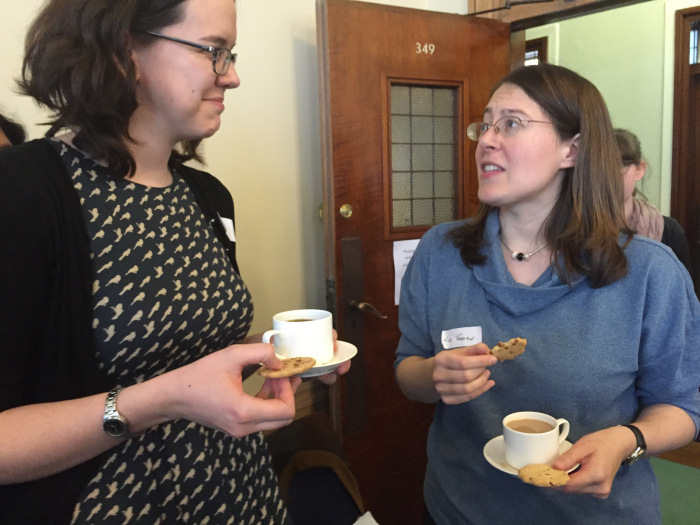
WCC and me – Dr Liz Gloyn

As part of our tenth anniversary celebrations, we are writing a series of blog posts in which members tell us about their experiences with the WCC UK. Our sixth interviewee is Dr Liz Gloyn.
Liz Gloyn is a Reader in Language Language and Literature at Royal Holloway, University of London. Her research includes work on Seneca the Younger and his approach to the family, and she is interested in feminist approaches to Latin literature. She has also published on the reception of classics in popular culture, with a particular interest in film and children’s literature. Her blog about classics and academia is titled ‘Classically Inclined‘. She was the first Administrator of the WCC, starting in 2016.
She discusses her involvement with the WCC with Katherine McDonald, current co-chair of the WCC.
KM: So how did you first get involved with the WCC? You won’t be surprised to hear that a few of our other interviewees have mentioned you in their answer to this question.
LG: Yes, in many ways it’s my fault! I did my PhD in the US, where there had been a Women’s Classical Caucus going since the 1970s; the rise of second-wave feminism had created a kind of solidarity for women across university departments there. They’ve been going ever since and they are still doing wonderful things. I found a lot of fellowship there as a graduate student.
When I came back to the UK to a Teaching Fellowship job and knew nobody, I didn’t have any kind of connection into any networks. One of the things I found myself thinking in those early years was, ‘wouldn’t it be nice if there was a WCC in the UK?’ Because the UK, where the numbers of Classicists were smaller, had missed that moment in the 1970s.
I sat on that thought for a bit while I was a Teaching Fellow, and then I landed a three-year job at Royal Holloway, which was eventually extended to become the permanent job I’m still doing now. My colleague Efi Spentzou put on a workshop with Genevieve Liveley called the ‘Classics and the New Faces of Feminism Sandpit’. They wanted to do something exploratory and interesting around feminist scholarship and thought. I went to that, and thought to myself, ‘wouldn’t it be a good idea if we used some of the energy in this room to make a WCC UK happen?’
I was very lucky to have fantastic people commit to the project who knew a bit more about the discipline, a bit more about organisational structures, a bit more about how you make stuff work. One of the things I am very good at is organising, and there were other people who were very good at thinking about strategy and keeping activity focused on our goals.
There hadn’t been a new membership organisation formed in Classics in the UK since, I think, the incorporation of the Council of University Classics Departments. The fact that we might start a new thing was radical and I’m actually really proud that since the WCC UK started, we’ve seen a lot more groups emerge to serve other communities that are marginalised within the discipline.
KM: What WCC initiatives or events have been particularly important to you or really stick out in your memory?
LG: It’s really hard to pick out one thing, because I had a finger in pretty much everything when I was Administrator, and everything was awesome. It was amazing to have so much enthusiasm and so many different kinds of people wanting to do things.
I remember we did an event at Birmingham on feminist pedagogy, and we’ve still got the resources up on the website for it. I was really proud of that as a way of centring feminist pedagogy as something we could do within the discipline. And it was so good to see lots of early career colleagues participating in that.
I have been really proud of our AGMs, and particularly that our AGMs travelled to different places. We had one in Cardiff and colleagues really appreciated that we’d brought the event to Wales. That was wonderful.
Speaking personally now, I am grateful for the Mid-Career event which caters to colleagues who are in that weird mid-career zone, and lets us talk about all of the challenges of that moment. That event creates a repeated space for people to come back every year and share where they are, meet new folks, see familiar faces, see colleagues talk about what’s happened in the interim. Mid-Career folks don’t get very much support in academia on the whole, but that space is so important.
And finally I’m proud of the work we do behind the scenes. I’m proud that we got to be a nominating body to REF. I mean, that wasn’t on my bingo card when we started. We can really engage and make sure that REF panel has a range of voices and genuine representation of the field. I’m also proud that the WCC is an organisation that is taken seriously and moves forward agendas in all sorts of exciting different ways.
KM: What has the WCC added to your life as a woman in Classics in the UK?
LG: Having a group which has the momentum to get stuff done has mattered. It has been delightful for me to see colleagues who had felt very disempowered in other settings succeed in the WCC’s environment. Seeing people flourishing, growing, blossoming and developing in their confidence. That’s been just as lovely as the benefit I’ve had myself from being part of mentoring triads, for example.
For me personally, it’s wild to think that my idea has made such a positive difference for people over the last ten years, and has had such direct and indirect effects on the discipline. As you know, I stepped down from being Administrator a couple of years ago to focus on other things, and to see people still getting so much out of it is the most rewarding part of the whole thing. It’s become a sustainable organisation for the long term.
KM: What would you say to someone considering joining the WCC for the first time, particularly if they are a PhD student or an early career researcher?
LG: We’re excellent value! But, seriously, I would say: do not underestimate the importance of finding people who speak your language. Of finding people who understand and appreciate a feminist approach to scholarship. We have had people come to talk at our events, as graduate students at spotlight talks for example, who have been a little bit stunned by the fact that their research has been taken seriously, when they’re used to an environment which is partly or entirely hostile to their approaches and their methods.