We are very excited to be starting preparations for the launch of our Short-term Mentoring Scheme. This is the final element of our new mentoring programme, which complements both the Take A Graduate Student To Lunch scheme we run at the Classical Association conference and the Mentoring Triads which are running this academic year for the first time.
The short-term scheme provides the possibility of consulting a mentor on a specific topic for a brief consultation by e-mail, for a short period of no more than three months. The WCC UK will maintain a database of mentors, and assign mentees to appropriate mentors as and when they sign up. Mentors and mentees may join the scheme at any time of year, and people may be both mentors and mentees at the same time.
In order to set up this scheme, we need mentors! The guidelines for mentors are as follows:
You should respond to your mentee’s initial email within two weeks.
You are not obliged to advise on any issues other than those that you signed up to the scheme to help with.
You should be clear and explicit about your ability to comment on any written material, and provide a clear timeframe of when you can provide comments if you are able to do so.
You agree to communicate by email in the first instance. Any other means of communication should be arranged at your and your mentee’s discretion.
Please remember that your mentee may have had different experiences from your own when giving advice.
Please make reasonable time for your mentee, and inform them of the timeframes in which they might expect to receive responses from you.
The scheme administrator will ensure that no mentor is overburdened at any given time.
After sign-up, mentors will be consulted annually as to whether they wish to remain on the database. You can request to be removed from the database at any time.
Signing up does not guarantee that you will be matched with a mentee.
The full WCC UK Mentoring Code of Conduct can be viewed here.
If you would like to sign up to offer support as a mentor as part of this scheme, please use this form.
The scheme will open for mentees in roughly one month’s time, once a database of mentors has been accumulated. Please note that you can still sign up to be a mentor once the scheme is open to mentees.
This scheme is for members of the WCC UK in good standing only; if you would like to sign up to the WCC UK, you can do so here.
The WCC UK steering committee and liaisons note that the University and College Union are calling for industrial action consisting of strikes from Monday 25th November to Wednesday 4th December, and action short of a strike from Monday 25th November. We support the aims of the strike, particularly since UCU is seeking to address issues around the gender and ethnicity pay gap, casualisation, stress and mental health which impact our members.
In our own launch survey, we identified that women were much more likely than men to be in casualised or part-time positions than men, even though about the same number of men and women are employed in the discipline. In a 2019 survey on the impact of casualisation in higher education, 71% of respondents said they believed their mental health had been damaged by working on insecure contracts and 43% said they believed that such contracts had affected their physical health. Other studies have also revealed that young workers are more likely to experience anxiety or depression if they are employed on temporary or casual contracts. The gender pay gap also exists at all HEI institutions where classics is taught; in the HE sector, women on average were paid 15.9% less than their male colleagues in 2018.
We recognise that the decision whether to strike or not is a difficult one, particularly for those in precarious employment. We encourage our members at striking institutions to consult the national UCU strike fund guidelines and to enquire about the details of their local branch strike fund, and then make decisions accordingly. Members at non-striking branches may wish to donate to the national fund or a nearby local fund in solidarity. If you have further questions about strike action, we encourage you to contact your local branch for guidance.
In response to feedback gathered from members, the WCC UK is developing a mentoring scheme with three strands. The first is the Take a Grad Student to Lunch Scheme, which ran successfully for the second time in Summer 2019. The second, launched here, is the Co-Mentoring Triads Scheme.
The Co-Mentoring Triads Scheme is designed to facilitate a fixed-term, mutually beneficial mentoring arrangement to be established among three members, to avoid the hierarchy present in traditional mentoring relationships. Co-mentoring triads will run for one academic year. Triads will be grouped together around specific themes and interests that the members wish to explore in the coming year, as well as other factors such as preferred method of communication and location. Members from all careers and career stages are welcome to sign up. Triads will be matched up by the Mentoring Officer and informed of their triad’s membership by the end of September.
Initial contact will be made by e-mail. Other methods of communication will be agreed upon at the triad’s discretion; these may include e-mail discussions, Skype calls or in-person meetings. Regularity of contact will be determined at the discretion of the triad. Triads are expected to contact each other at least four times over the course of the year. Worksheets and guidance will be provided by the WCC UK which may help to structure the mentoring arrangement. You are not obliged to use these, but they may help you to get the most out of your triad. Please be reasonable with your demands on your colleagues’ time and respectful of the commitment they have made to you. By signing up to the scheme you agree to abide by the WCC UK’s Mentoring Code of Conduct.
The scheme is open to all WCC UK members in good standing. Please sign up here by Friday 13th September. If you have any questions about the scheme, please contact the Acting Mentoring Officer, Christine Plastow, at christine.plastow [at] open.ac.uk.
The WCC UK warmly invites members to consider proposing an event to be held under WCC UK auspices.
As outlined in our events policy, we run events with an organising team made up of three people (or a triad), one of whom needs to be a steering committee member or liaison; any member is welcome to put an event proposal forward for the steering committee’s approval.
To help members who would like to put on an event but perhaps haven’t had any experience of event organising yet, we have put together a short guide titled So You’re Organising A WCC UK Event: An Event Organiser’s Starter Pack. It gives helpful advice on how to propose an event as well as useful tips on event organisation which we’ve picked up over the last few years. We hope that this pack will make organising a WCC UK event more straightforward, and will demystify some of the things that go on behind the scenes to get our programming together.
If you a PhD student or an early career colleague who is interested in finding out more about running an event but not quite ready to propose one of your own, we offer the opportunity to shadow a triad to gain some some experience of event organisation; if this sounds like something you would be interested in, drop a line to the Administrator at womensclassicalcommittee at gmail.com.
We’re looking for our next Treasurer! Our current Treasurer, Dr. Carol Atack, intends to step down from her post at our next AGM; we are looking for someone interested in taking over the role from April/May 2020 so that they have the opportunity to shadow Carol and get familiar with how the financial side of the WCC UK works. The Treasurer currently serves a five year term. The post would thus suit someone in reasonably stable employment, particularly with a fixed institutional postal address; these are desiranda rather than essentials, and we welcome all enquiries and expressions of interest.
Click below the cut to see a detailed role description of what the Treasurer currently does. If you’d like to discuss this opportunity in more detail or volunteer for the position, please drop us a line at womensclassicalcommittee at gmail.com.
Following our AGM in May, we have some new faces on the steering committee!
First of all, we offer our heartfelt thanks to Amy Russell and Rosa Andújar, whose terms as steering committee members has ended; to Jane Draycott, stepping down as ECR liaison; and Emma Bridges, stepping down as alt-ac and part-time liaison. Jane, Emma, Amy and Rosa are founding members of the WCC UK, and we are incredibly grateful to them for everything they have done for us as an organisation since we were founded. We also thank Vicky Donnellan for her service as alt-ac and part-time liaison. We look forward to working with them all as members in the future.
Our two new committee members, following the 2019 elections, are April Pudsey and Lizzie Lewis; April will be co-chair from April 2021.
On the liaison front, we welcome Amelia Dowler and Lily Mac Mahon, who join us as our new alt-ac liaisons; Anna Judson, who takes up the ECR liaison portfolio; and Manuela Irarrázabal Elliott, who is our new disability liaison. We also welcome Kathryn Adams and Miller Power, who join Katherine McDonald as part of our website and social media team.
Finally, we are grateful to Christine Plastow for taking on the role of Acting Mentoring Officer; building on our successful Take A Grad Student To Lunch scheme at the CA over the last two years, she will be overseeing the organisation of a new WCC UK mentoring scheme and has played a major role in planning what it will look like. Watch this space for more details.
Over the coming year, we are going to be thinking about the role of liaisons within the WCC UK and whether our current positions are operating as we would like them to. We plan to circulate a survey to members in the autumn to see what you think about what the WCC UK should be doing, including an opportunity to give us some feedback on these issues.
The Women’s Classical Committee UK is organising an event aimed at mid-career scholars, to be held on Friday 13th September 2019 at the University of Glasgow, from 11am to 4.30pm.
The Women’s Classical Committee UK run a mid-career event annually to help colleagues in open-ended employment discuss the issues and challenges that face academics, particularly women, at mid-career. Topics to be discussed may include decisions about whether and when to move institutions, questions around disciplinarity/interdisciplinarity and collaboration in research, expectations about international mobility and balancing this with family/caring duties, managing institutional expectations (which may be gendered) around types and levels of administrative service, taking on leadership positions, ways of supporting precarious colleagues, and strategies to tackle unconscious bias in the workplace. Those who register their intent to attend will be invited to fill in an online questionnaire, the results of which will inform the precise choice of topics for discussion sessions. We envisage that the day’s discussions will help to set priorities for resource development and future campaigns by the Women’s Classical Committee UK.
The WCC UK recognises that the term ‘mid-career’ is open to a range of interpretations, but also that different challenges face women in classics in different situations and career stages. This event is aimed primarily at women who self-define as having reached mid-career; markers of this may include being eight or more years after the award of their PhD, holding an open-ended contract, and having an established publication profile. If the event is oversubscribed then we will give priority to women in this situation, but we welcome applications to register from anyone of any gender who feels they would benefit from attending.
Registration Options
In-person registration is free for paid-up members of the WCC UK, who have received instructions on how to access this ticket type over e-mail. If you need the instructions to be resent, please e-mail us at womensclassicalcommittee at gmail.com. For non-members, tickets cost £10. You may register for the event at over at Eventbrite.
The WCC UK is committed to providing friendly and accessible environments for its events, so please do get in touch if you have any access or childcare enquiries. The catering for the event will be fully vegetarian; please indicate any further dietary requirements via the event’s online questionnaire in due course.
Child-friendly Policy
The Women’s Classical Committee UK is committed to making our events as inclusive as possible, and recognises that the financial and practical challenges of childcare often impede people from participating in workshops and conferences. Anyone who needs to bring a dependent child or children with them in order to participate in one of our events is usually welcome to do so, but we ask you to inform us of this in advance so that we can take them into account in our event planning and risk assessment.
Attendees who wish to bring children are welcome to do so; the safety and well-being of children remains their carers’ responsibility at all times.
The Women’s Classical Committee UK invites submissions for this year’s panel proposal for the Classical Association Annual Conference 2020 (Swansea University, 17-20 April).
Storying Gendered Emotions in Classical Antiquity
Organised by Maria Gerolemou (Exeter) and Irene Salvo (Göttingen)
Although studies on emotion in ancient Greek and Roman cultures are currently thriving, gender differences in emotional experience and expression have been comparatively little investigated. This panel aspires to invite further reflections on the topic. Discussion will focus on (but it is not limited to) the following interrelated themes and aspects:
1. Gender difference a) Gender-specific patterns of emotions: are there any stereotypical emotions that are considered socially acceptable for females and males? b) The way women and men experience and express emotions; e.g. verbal and non-verbal expression of emotion; different frequency and intensity of emotional expression.
2. Embodied narratives c) Storying emotion: Narratives that construct, thus shape their ‘consumer’s’ gendered emotional expression, or undo it. d) Forms of narratives that are conveyed through images, objects, monuments, or places, and that evoke a gendered emotional and embodied experience.
3. Queer readings e) Intersectional readings of emotional lives; emotions are considered to be agentic forces which are subject to various factors such as age, race, sexuality, and class; hence, whilst patriarchal culture can impedes agency, class as well seems to play a role in how members of the same gender tend to experience emotion (see e.g. slave women). f) Queering historiographical narratives on gender and emotion traditionally interpreted mainly as evidence of political or military history.
We warmly encourage Classicists at any career stage and of any gender to submit abstract proposals for 20-minute papers. Please send an anonymous abstract (300 words maximum) no later than Wednesday the 14th of August 2019 to womensclassicalcommittee at gmail.com.
Dr. Katherine Harloe of the University of Reading reports on discussions from our AGM.
We are all aware of the problem of casualisation in UK Higher Education,
as universities seek to cut costs, and respond to
volatility in student numbers, by relying on fixed-term staff rather than
creating open-ended posts. Many Classics Departments are presently in
institutions operating non-replacement of posts for permanent staff; others
have gone further and opened voluntary redundancy schemes, with compulsory
redundancies actively being considered for next year.
The result of all this has been a job market with very few open-ended positions advertised, and a large number of fixed-term, and/or fractional posts – many of which flout the recently (2017) revised CUCD protocol on employment of fixed-term staff. The Universities and Colleges Union, which is running an anti-casualisation campaign, called last year for staff to take industrial action in relation to casualisation; turn-out was, however, insufficient for this to take place.
Given this context, it seemed important for the WCC UK to address the problem of casualisation in discussions at our 2019 AGM. The casualisation break-out group held a very full, urgent discussion, which could have gone on for much longer given the scale of the problem and the multiple issues and disadvantages being faced. It was particularly useful to have a mixture of those at the sharp end of casualisation (including some who have by now spent up to a decade on short-term contracts, with no end in sight); finishing PhDs contemplating the academic labour market; more senior/established staff who might be in a position to influence institutions’ policies and practices, even at a local level; and active members of UCU branch committees.
It was agreed that the problem of casualisation has been getting worse in UK universities. Every year the jobs advertised appear to be fewer and worse in terms of working conditions/types of contract, and casualisation has clear, long-term negative effects upon individuals’ lives (including the ability to establish and maintain family life), research agendas, mental and physical health, as well as upon research cultures and the sense of academic community within and across UK Classics Departments.
Specific negative consequences of casualisation impact not only upon casualised academics themselves but also upon the undergraduates and postgraduates they teach or supervise. Since the latter are articulated less often than the former, it is worth noting that the ‘student-side’ problems noticed less often include lack of opportunities for doctoral supervision (a negative both for prospective supervisors and for prospective supervisees, if a person with particular expertise does not hold a position where they can supervise doctoral researchers); lack of continuity in lecturers and personal tutors, which can lead to lack of suitable referees when graduates are entering the job market. These all have a negative effect on ‘the student experience’ and student satisfaction; some casualised staff also feel that they are accorded less authority and/or respect, both by students and by colleagues, than staff on open-ended contracts.
A lot of the discussion centred around measures that could be taken at that level to alleviate the conditions of casualised staff, although the group recognised that bigger, structural questions need to be addressed if the UK HE sector’s ever-increasing reliance on casualised staff is to be reversed. Drawing on the experience of long-term casualised staff, we came up with a short wish-list of suggestions, in no particular order. These are addressed primarily to Heads of Department and Departmental Directors of Teaching and Learning, that could ease, even if only marginally, the lives of casualised staff
1. Pay relocation costs of staff arriving to fill temporary contracts. This is something that is almost never offered, although a few departments now require any permanent staff who are applying for research funding that includes teaching replacement to include relocation costs in their project costings, where this is an allowable expense under the scheme.
2. Aim to offer a minimum 12–month contract, which includes research time/university vacation pay. Some discussion took place around the challenges faced by those who had spent a long time on fractional, teaching-only contracts in maintaining their competitiveness for contracts which included a research element, but it was felt overall that it was better to hold teaching and research together if at all possible, since this would be of greatest long-term benefit to aspiring academics.
3. Increase uniformity in application procedure/expected paperwork for temporary posts, across different UK Classics Departments. Ideal from the point of view of prospective applicants would be a single, simple, online form for all UK Classics applications; although this is probably unrealisable, it was felt that the application process could often be simplified and Classics departments could collaborate, through subject associations, to increase uniformity in some areas. The next two points also relate to this:
4. Make the eligibility criteria explicit in job advertisements and further particulars. In particular, different definitions of ‘early-career’ are used in the sector and in different institutions; this can involve a great deal of wasted effort when prospective applicants discover at a late stage that they are not in fact eligible for a particular postdoc or funding scheme. It was felt strongly that an ‘early-career researcher’ should be redefined as ‘someone who does not have a permanent academic post’.
5. When designing an application process, consider carefully what you require of candidates at each stage, and consider only taking up references, asking for research samples, etc., at point of shortlisting. It is asking a lot of candidates to expect them to produce detailed, institution-specific module plans before they have even been longlisted, and requiring references at Stage 1 increased burdens on candidates and referees. Consider whether you can long-list, or even short-list, on the basis of CV and covering letter/application form alone.
6. Offer honorary, non-stipendiary research positions after close of contract, to enable underemployed or unemployed scholars to maintain some library/electronic resources access, as well as access to academic community. A related suggestion, for WCC UK to take up, was to ask the Institute of Classical Studies to consider establishing an electronic resources/institutional email account for independent scholars who are paid-up members of Senate House Library.
7. Prioritise the needs of casualised staff when timetabling teaching. Pull out all the stops to bunch their teaching onto fewer days in order to minimise their travel costs if commuting long distances to fulfil a fractional contract (see too point 1 above)
8. Allow casualised staff, even on teaching-only contracts, access to conference expenses funding, research and development opportunities, and institutional research support (e.g. help with grant writing) that is available to staff on open-ended contracts. This is appropriate in recognition of the fact that many such staff are experienced and/or aspiring researchers who have a contribution to make beyond their immediate labour as lecturers.
Many of these recommendations correspond to those made in the openly available Council of University Classical Departments Protocol on Academic Staffing, last revised 2017. It was felt that UK Classics Departments, many of whom are CUCD members, could be more mindful of this document than they have proven to be so far.
Dr. Victoria Leonardwrites, giving us an update on the #WCCWiki team’s activities this month.
With two major conferences in ancient and medieval studies back-to-back, early July 2019 was a particularly productive time for those who work across both disciplines. The gender bias of Wikipedia transcends boundaries of study, and women in both fields are poorly represented on the largest and most influential source of information in the world. #WCCWiki embarked on an epic mission to rebalance the gender gap at both the Leeds International Medieval Congress, 1-4 July and the FIEC/Classical Association Conference, 5-8 July 2019.
Following an enormously successful
roundtable on #Foremothers in the morning, a Wikipedia editathon to improve
the representation of women in Late Antique, Byzantine, and Medieval Studies
was held in the afternoon on Tuesday 2 July. It was organised by Dr Victoria
Leonard and Sukanya Rai-Sharma, and was co-sponsored by the Women’s Classical Committee (UK) and the Society for Medieval Feminist
Scholarship.
The event was free and open to the
public. Dr Kate Cook delivered an expert training session for those who had
never edited Wikipedia before, which was followed by a communal editing session,
also supported by Dr Richard Nevell. Our scope was wide and included women
related to Art History, Archaeology, Digital Humanities, Modern Theories,
Religious Studies, and Theology as well as History. #MedievalWiki attracted 15 editors, with 14 women and 1 man. We
were able to edit 25 articles, create 2 new articles, and add 4,300 words to
Wikipedia on women historians. The articles we created and edited attracted over
4,000 page views in five days.
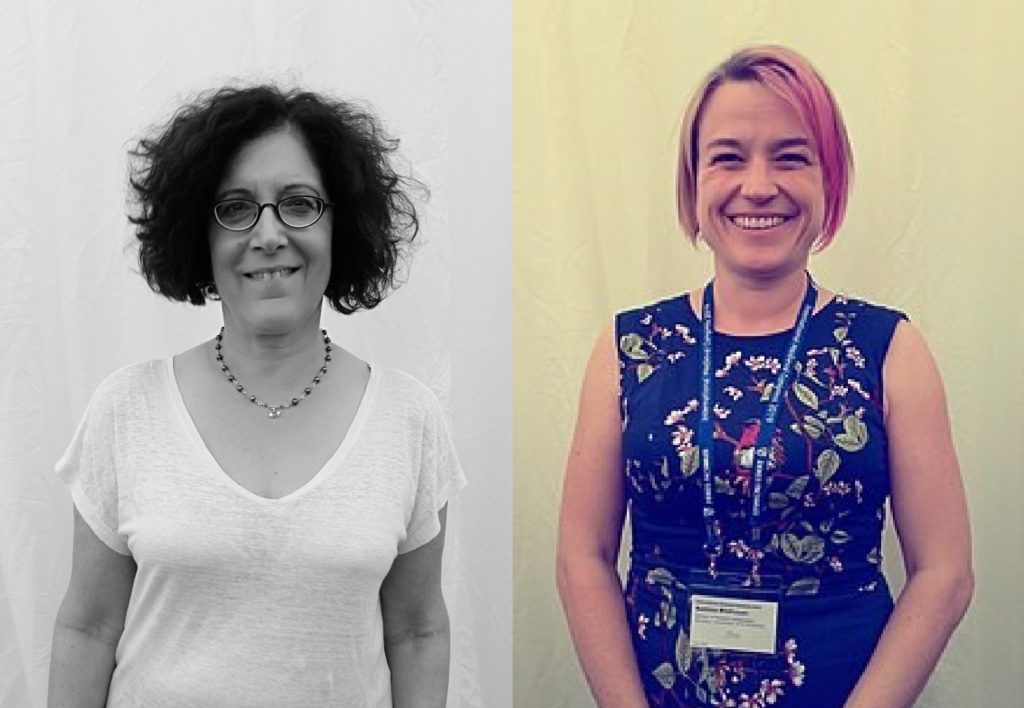
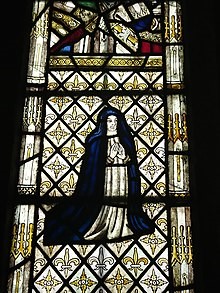
Our achievements included a new article for Professor Geraldine Heng, author of The Invention of Race in the European Middle Ages, and a new article for Professor Ruth Dean, an expert on Anglo-Norman literature. Other articles were improved such as those for Professor Monica H. Green and Susan Reynolds. Pictures were taken at the IMC of Professor Miri Rubin and Professor Bettina Bildhauer which were uploaded to their pages. The page on Llanllugan Abbey, a monastery of Cistercian nuns and one of only two Cistercian women’s monasteries in Wales, was improved and a beautiful image of a stained glass window depicting a nun kneeling in prayer was also uploaded.
Professor Miri Rubin and Professor Bettina Bildauer
On Friday 5 July, three days after
#MedievalWiki, an editathon was held to improve the representation of women Classicists
(broadly conceived) at the FIEC/Classical Association Conference. Katie Shields
and Dr Anna Judson led the training, with productive interjections from Professor
Juliana Bastos Marques. As at #MedievalWiki, 1-2-1 guidance was available for
those learning to edit Wikipedia following the training.
The event attracted about 18 attendees
in total, all of whom were women. Professor Sarah Bond and Juliana Bastos
Marques were notable exceptions as senior women; most people who attended were
graduate or early career women, as is the trend. Both events were well
organised and received excellent institutional support. Our inclusive and
friendly atmosphere made the events fun and created solidarity, and no one got
left behind or stuck learning to edit. We were able to disseminate valuable
digital humanities skills alongside reasons to use them.
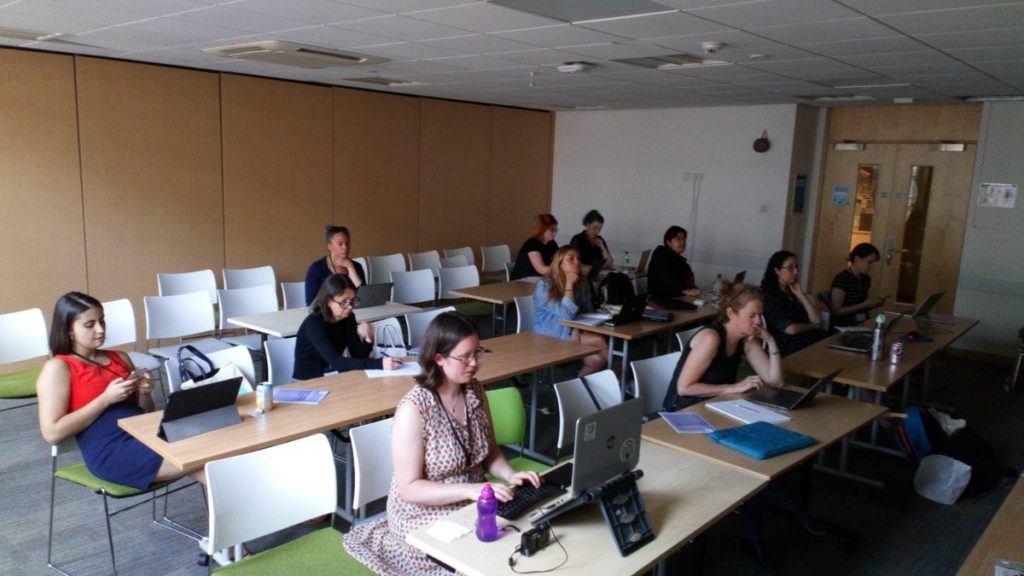
Contributors at #WCCWiki, Institute of Education, University of London, 6 July 2019
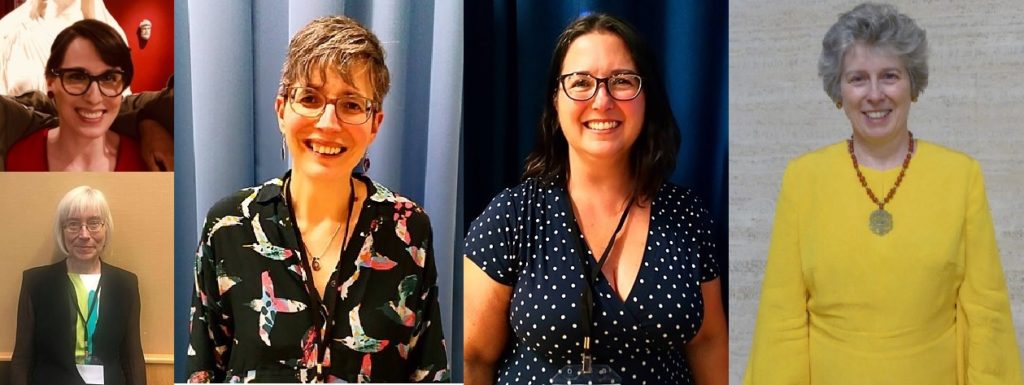
Through the #WCCWikievent we created two new articles, edited 18 articles, and added 4,500 words to Wikipedia. These pages received over 200 page views in two days. We also uploaded five images, featured on the Wikipedia pages for Professor Sarah Bond, Professor Helen Lovatt, Professor Rebecca Futo Kennedy, Professor Alison Keith, and Professor Judith Mossman. Our contributors created pages for Professor Lydia Baumbach and FIEC (Fédération internationale des associations d’études classiques).The page for Professor Ida Ostenberg was created a while ago and is a solid collaboration between #WCCWiki editors, and now includes an image. When the plenary speakers for CA/FIEC were announced, none of the women speakers had pages, a situation transformed by #WCCWiki.
Professor Sarah Bond, Professor Alison Keith, Professor Helen Lovatt, Professor Rebecca Futo Kennedy, Professor Judith Mossman
There is, of course, still much work to
be done. The keynote speaker at the CA/FIEC Professor Corinne Bonnet still does
not have a page, and the page for Professor Paula da Cunha Corrêa does not have an image. Two of the women keynote
speakers at the IMC, Professor Maria Giuseppina Muzzarelli and Professor Emma
Dillon, do not have Wikipedia pages, and Professor Marina Rustow‘s
page has no image.
We are always looking for contributors,
and we would especially like to diversify our editing community. #WCCWiki
continues to attract few participants who are men; we warmly appreciate our
contributors who are men. It would be fantastic to receive more support from a
wider demographic, including men and more senior historians and academics; the
burden of this labour is falling on the shoulders of precarious, under or
unemployed, early career women as facilitators and contributors. The
intersectional representation of women historians online is everyone’s
business, and everyone benefits from this representation being improved.
If you would like to find out more
about #WCCWiki, please visit the Project Page here. You can also search for #WCCWiki and
#MedievalWiki on Twitter without needing an account, and here and here are threads about these events. You can also
follow @tigerlilyrocks (Victoria Leonard), @Anya_Raisharma
(Sukanya Rai-Sharma), @SocietyMedFem (Society for Medieval Feminist Scholarship), and @womeninclassics
(Women’s Classical Committee UK).
Stained glass window at Llanllugan Church, depicting a kneeling nun
The organisers would like to thank the International Medieval Congress, Fédération internationale des associations d’études classiques, the Classical Association, and Wikimedia UK for their invaluable and generous support of our initiative, without which these events would not have been possible. We especially acknowledge the time and expertise of the women trainers which was freely given in all senses.
We use cookies to ensure that we give you the best experience on our website. If you continue to use this site we will assume that you are happy with it.