We are pleased to announce the WCC’s organisation and sponsorship, with the History Department at the University of Huddersfield, of two round-tables at the Leeds International Medieval Congress 2017.
The first round-table (Session 406), Feminist Pedagogy from Antiquity to the Middle Ages, brings together experts from across the disciplines of medieval history, classics, archaeology, heritage studies, and English literature. Discussion will focus on gender and women, uniting customarily disparate voices in the productive exchange of experiences and approaches to feminist and inclusive pedagogy. Discussion will be structured by the following themes: i. What is feminist pedagogy, and how do we do it? ii. Finding feminist pedagogy in language and translation teaching; iii. Finding the female voice in primary sources; and iv. The value of teaching and pedagogical research as a gendered issue. The round-table will be chaired by Patricia Cullum, and participants will include Carol Atack, Sarah Bond, Liz Herbert McAvoy, Sharon Marshall, Diane Watt, and Emma Jane Wells. The round-table will take place on Monday 03 July, 19.00-20.00.
The second round-table (Session 914), Crossing Chronological Boundaries, brings together academics whose combined expertise covers a large swathe of history, from classics to the middle ages. The event facilitates a rare dialogue that crosses the barriers of periodisation, and seeks to break them down. With a particular focus on gender and women, discussion will highlight areas of intersection and difference between classics and medieval studies as disciplines and as fields of research, with discrete pedagogical approaches. Discussion will question the value of periodisation, and the segregation of gender within the strictures of a periodised approach to the past, asking how such categorisation can be renegotiated. The round-table will be chaired by Victoria Leonard, and participants will include Conrad Leyser, Jacqueline Murray, Julia M. H. Smith, Rachel Stone, Shaun Tougher, and Robin Whelan. The round-table will take place on Tuesday 04 July, 19.00-20.00.
Wikipedia currently hosts around 200 biographies of classicists, of which only approximately 10% are of women. This WCC initiative is taking steps towards redressing this gender imbalance, by training and encouraging classicists to edit Wikipedia with this focus.
We are offering a free face-to-face training event and editathon, supported by Wikimedia UK, to launch a programme of more informal remote editing sessions. This launch event will take place at the Institute of Classical Studies (ICS), Senate House, Malet Street, London WC1E 7HU, from 10.30-17.30 on 23rd January 2017.
Thanks to the generous sponsorship of the ICS this event is free to attend, with lunch and coffee provided. Places are, however, limited, and registration is therefore essential. For those unable to travel to London, participation via Skype is also possible. Participants with disabilities are welcome; if you need particular support to enable you to take part, please let us know.
To reserve a place (either to participate in person or via Skype) and for further details please email the organisers, Claire Millington (claire.millington [at] kcl.ac.uk) and Emma Bridges (e.e.bridges [at] open.ac.uk) by 16th January 2017.
Child-friendly policy
The Women’s Classical Committee is committed to making our events as inclusive as possible, and recognises that the financial and practical challenges of childcare often impede people from participating in workshops and conferences. Anyone who needs to bring a dependent child or children with them in order to participate in one of our events is usually welcome to do so, but we ask you to inform of us this in advance so that we can take them into account in our event planning and risk assessment. The safety and well-being of any children brought to our events remain at all times the responsibility of the parent or carer. While we do our best to ensure that rest and changing facilities are available for those who may need them, this will depend on the individual venue we are using. Again, please contact us in advance to discuss your needs, and we will do our best to accommodate them.
Women’s Classical Committee UK workshop for mid-career women classicists, Monday 12th December 2016, KCL
The Women’s Classical Committee is organising an event aimed at mid-career scholars, to be held on Monday 12th December 2016 at King’s College London (Strand Campus), from 10am – 5pm. This event follows on from feedback received after the WCC UK launch event held at the Institute of Classical Studies in April 2016, which suggested a need for a workshop dedicated to discussion of issues and challenges that face women academics at mid-career. These may include decisions about whether and when to move institutions, questions around disciplinarity/interdisciplinarity and collaboration in research, expectations about international mobility and balancing this with family/caring duties, managing institutional expectations (which may be gendered) around types and levels of administrative service, taking on leadership positions, and strategies to tackle unconscious bias in the workplace. Those who register their interest in participating (registration link below) will be invited to fill in an online questionnaire, the results of which will inform the precise choice of topics for discussion sessions. We envisage that the day’s discussions will help to set priorities for resource development and future campaigns by the Women’s Classical Committee.
The WCC recognises that the term ‘mid-career’ is open to a range of interpretations, but also that different challenges face women in classics in different situations and career stages. This event is aimed primarily at women who have already achieved employment stability and established a publication profile but have not yet, or have only recently, been promoted to Professor. If the event is oversubscribed then we will give priority to women in this situation, but we welcome applications to register from anyone who feels they would benefit from attending.
The workshop is free to WCC UK members; for non-members the cost is £10 per head, to cover provision of lunch and other refreshments. It will take place in a room that is wheelchair-accessible.
To declare your interest in participating in this event please complete the registration form at the following link by Monday 14th November 2016:
Upon registering you will asked to complete a short online survey in order to help us structure the event according to your priorities.
For any queries about this event not covered by this announcement, please contact the organisers on womensclassicalcommittee@gmail.com. For more information on the Women’s Classical Committee, including our aims and activities and how to join, please see our website.
– The Women’s Classical Committee.
Child-friendly policy
The Women’s Classical Committee is committed to making our events as inclusive as possible, and recognises that the financial and practical challenges of childcare often impede people from participating in workshops and conferences. Anyone who needs to bring a dependent child or children with them in order to participate in one of our events is usually welcome to do so, but we ask you to inform of us this in advance so that we can take them into account in our event planning and risk assessment. The safety and well-being of any children brought to our events remain at all times the responsibility of the parent or carer. While we do our best to ensure that rest and changing facilities are available for those who may need them, this will depend on the individual venue we are using. Again, please contact us in advance to discuss your needs, and we will do our best to accommodate them.
Our members may be interested in the following call for papers:
Call for Papers: “Transnationalisms, Transgressions, Translations”
The 12th Conference of the International Federation for Research on Women’s History/Federation Internationale Pour la Recherche en Histoire des Femmes (IFRWH/FIRHF) will be held August 12-15, 2018 at the University of California, Santa Barbara, USA, the home of the current President, Eileen Boris. This will be the first time that this international gathering of historians of women and gender will assemble in the United States.
The theme, “Transnationalisms, Transgressions, Translations: Conversations and Controversies,” probes the meanings of boundaries and frameworks, narratives and epistemologies, analytic terms and foundational categories, global, national and local understandings, interactions and power relations across time and space. We are open to proposals for complete panels (chair, commentator, three papers) as well as individual papers, roundtables, conversations, workshops, and non-traditional forms of presentation.
*Transnationalisms: This sub-theme reflects the international turn in this era of globalization and the commitment of IFRWH/FIRHF to international histories and comparative panels in such areas as women’s and gendered movements, transnational organizations and global governance, state socialist and third world /global South manifestations, settler societies and Empires, imperialisms and colonialisms, anti-imperialism and anti-imperial uprisings, global labor, individual life trajectories, the traveling across space (and time) of ideas and objects, labor and sex trafficking, mobilities and immigration/migration, and related areas.
*Transgressions: This sub-theme considers the ways various peoples over time and space define the transgressive from dominant and accepted norms of being, identity and behavior as well as the self-conscious transgressions against hegemonic gender in relation to other social factors. Papers might consider outlaws and criminalization, deviancy, rebelliousness, genderqueer and trans*gender identities and practices, witches, “bad” mothers, gender bending dress or labor, crossing race/ethnic or class/caste lines, revolutions and social movements.
*Translations: How do terms of analysis travel across languages, disciplines, and time and space? What is lost in translation and how can we forge a transnational praxis when we cannot always speak well to each other? We are especially interested in the place of orality and how national historiographies and cultures of intellectual life (including the place of women’s and gender history and feminist and gender studies/theory) address concepts like gender, race/ethnicity, class, sexualities, agency, identity, power, (post)colonialism, globalization, feminisms, and development.
Founded in 1987, IFRWH is affiliated with the International Congress of Historical Sciences/Comité Internationale des Sciences Historiques and consists of national affiliates from across the globe, which link scholars together in a transnational network. Beginning in 2020, it will award the Ida Bloom-Karen Offen Book Prize in Transnational Women’s and Gender History (named after two of the most active founders of the organization.) Though the language of the conference is English, and the languages of the organization are French and English, we will seek to have plenaries with translation into Spanish and from French and Spanish into English. But we want to problematize this issue and invite suggestions on how to make this component of the conference accessible. In addition, as funding permits, we will plan on having modest subventions for graduate students, and scholars from areas of the world or institutions without resources.
Our submission link will go alive by November 1, 2016; we will accept proposals until March 15, 2017. Send inquiries to: ifrwh18@gmail.com
After our successful and thought-provoking feminist pedagogy event in July, we invited the speakers to write up their spotlight talks as blog posts, to share their experiences with our wider readership. Our first post is from Stephe Harrop, Lecturer in Drama (Shakespeare and the Classics) at Liverpool Hope University.
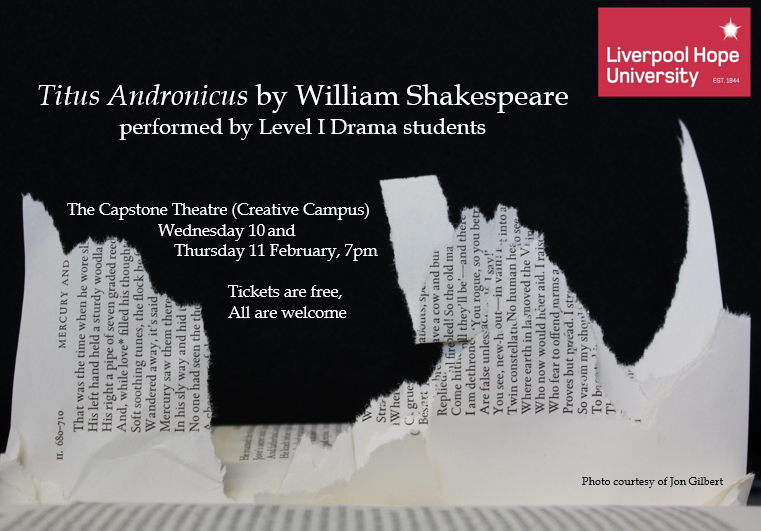
Titus Andronicus poster (image credit Jon Gilbert)
This post reflects on an undergraduate production of Shakespeare’s Titus Andronicus I directed in spring 2016 at Liverpool Hope University. This would not have been my first choice of play for a high-stakes student assessment with a second-year cohort I was only just getting to know, so I want to start by thanking the group who would become the Titus Andronicus ensemble for suggesting such a challenging project, and for their stamina and creative courage throughout. I’m also grateful to my colleague Louise Wilson, early modern scholar and book historian, for her unfailing insight and support.
Titus Andronicus is both crammed with classical allusion, and (in)famous for its extreme, often sexual, violence, many of its worst excesses directly drawing inspiration from Ovid’s Metamorphoses, with the tale of Philomela-Tereus-Procne a recurring point of focus. In the play, Titus’ daughter is raped and mutilated in an attack explicitly modelled on Tereus’ treatment of Philomela (2.3.43-44), though calculated to exceed its cruelties (2.4.38-43). There follows a long, poetically elaborate, and self-consciously Ovidian description of her mutilated body, delivered by Lavina’s uncle (2.4.11-57). In The Rhetoric of the Body from Ovid to Shakespeare (2000), Lynn Enterline highlights the ‘supremely literary origin’ of the acts ‘written on Lavinia’s body’ (8). She argues that despite Lavinia’s unwillingness ‘to be interpreted yet again by the book written across her wounded body’ her narrative is ‘relentlessly pulled back to the story of Philomela’ (8). Lavinia’s body becomes the page upon which male readers of Ovid forcibly inscribe their own meanings.
I knew, from the outset, that I wanted to include some of Shakespeare’s classical intertexts within our performance, giving students the opportunity to engage with Titus Andronicus as operating within an extended heritage of literary violence. I thought of using Lavinia and Young Lucius as a focus for these intertextual moments, since we know that Lavinia is literate, and before the play begins she’s been reading to and with her nephew (4.1.13-15). She’s a sophisticated enough reader to make jokes drawn from her knowledge of Ovid’s Metamorphoses in the moments before she is attacked (2.3.70-71). I pictured her, modern paperback in hand, reading Ovid aloud with Young Lucius. And then another image started to form in my head. Lavinia, mutilated and mute, with pages torn from her own copy of Ovid forced into her mouth. A woman reader, to borrow a phrase from Shakespeare’s Julius Caesar (1.2.89-90), ‘put to silence’. That’s where I started from.
This directorial choice had unintended, but important, consequences. First of all, it meant that multiple copies of Ovid’s Metamorphoses were present in the rehearsal room from the beginning of our process. In consequence, as we began to develop our physical skills as an ensemble, we were also beginning to explore the book as material object; something to be thrown, caught, dropped, recovered, creased, smoothed, passed from hand to hand. Then we grew bolder. We began to incorporate these books into scenes where, officially, they had no place, contexts in which they might be snatched, slammed, weaponised, ripped, their pages shredded, scattered, or destroyed. Ultimately, these books became a central component of the production’s minimalist aesthetic, their use not confined to the single scene in which Shakespeare brings a copy onstage in order for Lavinia to identify the likeness between her own experience and the story of Philomela (4.1). Wherever Shakespeare’s play performs violence upon bodies, we began to perform the same violence upon books. Ripped from Alarbus’ and Bassianus’ guts, spilling from Lavinia’s mouth and hands, bundled into a shawl to represent Aaron’s newborn son, and unceremoniously tipped out again to serve as Titus’ Ovid-inspired cannibal banquet, chewed, spat out (maybe even occasionally eaten), torn pages from the Metamorphoses became the physical stuff from which we created our Rome.
The Aftermath (photo Stephe Harrop)
Reflecting on this process, it seems to me that live performance’s physical presence potentially allows us to place a new emphasis upon the materiality of classical texts, changing the range of things we’re able to do with and to them. We’re all too familiar with the idea that books do things to bodies. Current debates about curriculum content, trauma, and trigger warnings are predicated upon the (often unspoken) understanding that ancient literary materials may, in Alex Wardrop’s phrase, create ‘hurt at this moment, in this room, right now’ (18). (See, for example, recent reflections on the subject from Liz Gloyn, Fiona McHardy and Susan Deacy.) However, drama’s physical interactions make it a pedagogical context within which we can also do things to books, unsettling conventional understandings of classical text as inviolable, while students’ bodies may have been violated and damaged in all kinds of ways. In directing Titus Andronicus, I found that bringing copies of the Metamorphoses into the rehearsal space allowed my unease about the tragedy’s pleasure in re-playing Ovidian violence to assume a tangible, material presence. And, as these books became central to the ensemble’s creative process, I also discovered that transforming our thinking about canonical texts – acknowledging and exploring the material presence of the book, as well as the ancient poem it contains – can potentially open a provocative space for students to develop their own critiques of, and resistances to, a classical play’s re-performed atrocities.
I’m retiring in January. I’ve managed (and that word suggests more of a conscious process than it should!) my academic career without a single day of unemployment. But this doesn’t mean it’s all been a bed of roses, and I’m writing this to share my experiences of uncertainty and to tell people how it was in my past, and how I coped, from starting my PhD in 1980. While some things were easier, getting a permanent job in academia wasn’t one of them.
How PhDs worked…
Doing a PhD wasn’t inevitable! Actually, neither was going to university; I’d worked in a bookshop for a year after leaving school, as I wasn’t sure university was for me. I never intended to do a PhD – I didn’t know what one was, or what it involved. I went straight from a combined honours BA in Ancient History/Social Anthropology at UCL to PhD work there, simply because further study had started to appeal, and because I got the funding from the Department for Education. There was no interview: I assume funding was allocated by degree result and references. I’d only had to write about 15 lines on my topic, ‘Ancient Greek concepts of time’, in contrast to today where it seems you need to have pretty well written the PhD thesis in order to persuade anyone to fund you. I’d have been stretched writing more than 15 lines!
Hurdle no.1 safely over, I had six months of not having a clue what I was supposed to be doing. I hadn’t written a dissertation as part of my BA, and here I was contemplating 100,000 words on… well, something. The MA as PhD preparation didn’t yet exist. I eventually got stuck into an analysis of Hesiod’s myth of the 5 ages/races, went along to seminars at the ICS, and started to realise I was interested in ‘time’ in the sense of the female life cycle. I had just one supervisor, Sally Humphreys, chosen because she had started up the combined honours degree I had taken, and therefore knew where I was coming from. I worked with her on editorial work for Mortality and Immortality: The Anthropology and Archaeology of Death (1981) which taught me something about academic writing. There were no skills seminars for postgrads. Essentially, I felt lost all the time.
Sally felt I needed a change of scene and persuaded the funders to let me go to France for 5 months to sit at the feet of the Paris structuralists. I had a great time (how long have you got??) at seminars and lectures and going to the cinema and at the end of it felt sufficiently guilty about the lack of any real research to offer a paper to a new series the ICS was about to put on. This made me buckle down to serious work on my return. I sent the resulting paper, ‘Bound to bleed’, to the Journal of Hellenic Studies, which rejected it in a not particularly sensitive manner, but then the paper was solicited for the collection Images of Women in Antiquity. Not only in Paris, but in the UK I attended lots of conferences, started to network, and found people who would become my referees. At conferences, Sally would always prod me and insist ‘Ask a question!!’ She was right: I began to become visible.
And then??
‘B2B’ came out in 1983: hurdle no.2, a publication (a very short one). Even before it appeared in print, as my sole output it became my ‘research fellowship piece’ when, encouraged by Sally, I did the rounds of the Oxford and Cambridge JRFs. Most people were submitting as their ‘piece’ a draft of their thesis! Supported by a reference from Geoffrey Lloyd, to whom Sally had introduced me, and by supportive UCL staff, I had many interviews and many rejections. I was often the only woman being interviewed, usually the only person not to come from Oxbridge, and certainly the only person working on bodily fluids. It was dispiriting in the extreme. Because what was being tested wasn’t just your work, but your fit with the college, rejection extended further into the psyche than it normally does. And then Newnham offered me a JRF… Hurdle no.3 safely overcome.
Looking for jobs
I still didn’t feel that an academic career was inevitable. I didn’t finish the PhD thesis until a year or more into the JRF. I gained teaching experience giving occasional lectures on other people’s courses. I did more research. But there were no ‘proper jobs’. I remember sitting down at a conference with a fellow London PhD graduate, analysing the pedigrees of nearly all those with permanent Classics jobs in the UK. All from Oxbridge: we seemed to have no chance at all, but in any case the market was stagnant. In some desperation, as my three JRF years drew to a close, I tried and failed with the Civil Service and the prison service, while applying for more research fellowships, in the US, Rome and Newcastle.
Helen at her PhD graduation
I thought the Newcastle interview went well but I heard nothing from them. Meanwhile I was offered one-year fellowships in the US and in Rome. But one year isn’t very long, and Newcastle was a two-year post, so after a week of waiting I phoned Newcastle and they were surprised I hadn’t received the letter offering me the post… Yes, that does happen.
I don’t count Newcastle as hurdle no.4, because in an important way it made me even less employable. The terms of the fellowship meant I could only give about one lecture a year, and I did no marking or examining. While at Newcastle, I applied for every Classics job going, and some Anthropology jobs, with depressing results. Interviewers would ask ‘Wouldn’t you be happier in a research institute?’ I wanted to shout no, no, a thousand times no: I want to have a proper job like you’ve got! One of the jobs I went for was at Liverpool Institute of Higher Education: the job spec was to teach Roman Britain, in a History department. I had never studied Roman Britain, had hardly ever taught anything, and all the others being interviewed were archaeologists specialising in it. So, no chance. But I got the job. Why? Partly because it was a Church foundation and I was on the Church of England’s General Synod at the time – some on the panel thought I would be useful if their funding climate got tough. Partly because the HoD wanted to expand the ancient side of things, so I soon found myself teaching Greek history, Roman republic, Roman Empire, religion and women. You never know what is going on behind the scenes of the department to which you apply.
Jobs
Liverpool was where I learned to teach, thus meaning I’d crossed hurdle no.4. Many colleagues were from school-teaching backgrounds and around half our students were on the B.Ed programme. The library was full of books on how to teach and, as in a school, staff took breaks at the same time and could share ideas and information. 30% of the students were mature, which was challenging and enjoyable, as they were really enthusiastic about the chance they’d been given to study history. In that first year I was barely one lecture ahead of my students, preparing lectures every night. I was also a resident tutor, which meant gaining experience of pastoral care, often at 3 a.m.
After 8 years at LIHE, a change of senior management gave a sense of vulnerability to an ancient historian, and I began looking around. The Wellcome Trust was starting its University Awards: five years of gradually reducing funding from the Trust with the host university putting in more and then guaranteeing a proper job at the end. I approached one university, which didn’t want me. I then tried Reading, where the then-Head of History could see the scope for a joint appointment with Classics, factoring in probable retirements over the next five years, and he set up interviews and negotiated with the Trust. So I was back in the ‘university sector’ again. That meant becoming an employer rather than a candidate, and in 2007 I wrote some advice to job applicants from that point of view.
I moved from Reading to the OU for a range of reasons; not least of them, that the (excellent) Classics department were all put at risk of redundancy, in a cynical move about which I should probably say no more here. It doesn’t matter if you’re a professor, with a strong REF entry, and all the other things we’re supposed to have: the process of writing a 2-page document on ‘What I can offer Reading in the next 5 years’, as a way to save your job, gives you a strong urge to say ‘I can offer my resignation…’ Coincidentally, the OU advertised for a professor at the time I was writing this document. I’d applied to the OU maybe 20 years earlier (where haven’t I applied, over the decades?) and was turned down after interview. This time, I made it successfully through two days of interviews, to a job which I described then as ‘going as far as you can in UK HE without falling off the edge’.
Is it worse now?
What do I conclude from all this? That, yes, some things are worse now. You’re supposed to have pretty well written the PhD before you’re offered any funding to do it. You’re supposed to have the publications, the teaching experience, the big grant, the experience of outreach and the possible impact case, even before you have a proper job. And there are so many more people with PhDs, and the squeaky new PhD with a thesis that is likely to become a monograph within the next two years will always look attractive for the REF. But some things are better. One of the side effects of the grant culture, and of proper maternity leave (and more women in permanent jobs!) is that temporary posts are even more common, although the pattern of moving from one of these on to another, with completely different teaching to prepare each time, is demoralising and not conducive to research. The presence of more women in the academy means that it’s more common for the long-hours culture to be challenged and meetings to be held within the working day. I didn’t have children and didn’t marry until my forties, so I often worked on Saturdays: I don’t expect any of my colleagues to do this now.
Looking back, my advice would be to network. Attend conferences. Ask questions. Acquire possible referees, treat them well (no last-minute requests for a reference) and if you have any suspicions that they are just churning out the same generic reference rather than targeting it to the person spec, get new ones. Write the book: don’t get side-tracked by any other writing until you’ve done that (I ignored that advice – I couldn’t have got away with it today). Live with your imposter syndrome: most of us have it, and you just need to do what you do as well as you can. And, as I said at the WCC pedagogy event, make sure you do something else, whether it’s caring for a family, growing vegetables, helping in your community, devoting energy to your hobby – the inevitable disappointments and rejections hurt more if what is rejected is all that you are.
Finally, the best piece of advice I ever received, from a colleague at LIHE: ‘Be yourself – only more so.’
On Friday 8 January, three members of the WCC UK steering committee, Rosa Andújar, Lisa Eberle and Amy Russell met with the current co-chairs of the Women’s Classical Caucus (https://wccaucus.org/), Sarah Blake and Chiara Sulprizio, WCC veteran Ruby Blondell, and the current president of the Australasian Women in Ancient World Studies (https://socawaws.wordpress.com/), Sonya Wurster. In addition to discussing practicalities related to setting up an organization devoted both to achieving gender equity and to addressing issues specific to women in classics, we considered various opportunities for collaboration between the three organizations. WCC UK is looking forward to working closely with its American and Australasian counterparts!
We use cookies to ensure that we give you the best experience on our website. If you continue to use this site we will assume that you are happy with it.