WCC and Me – Dr Irene Salvo
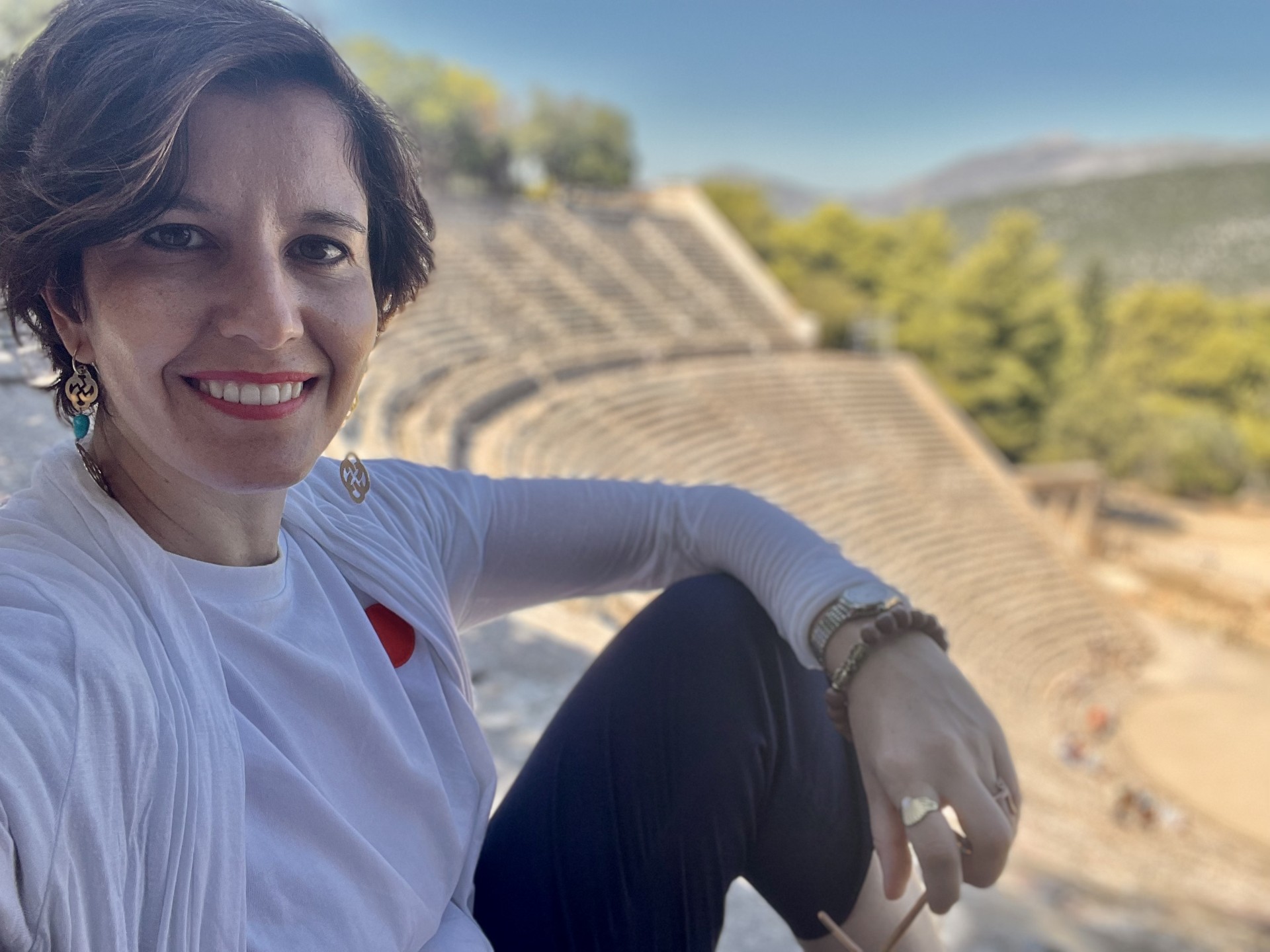
As part of our tenth anniversary celebrations, we are writing a series of blog posts in which members tell us about their experiences with the WCC UK. Our first interviewee is Dr Irene Salvo.
Irene Salvo is a Lecturer in Ancient Greek History at the University of Verona. She has been a LGBT+ activist since many years, promoting the visibility of queer identities in the field of Classics and Ancient History as well as harnessing the power of Greek and Latin sources to fight homo-transphobia through education today.
She discusses her involvement with the WCC with Katherine McDonald, current co-chair of the WCC.
KM: How did you first get involved with the WCC?
IS: Basically, I have been involved with the WCC since the very beginning. It was 2015 in London, and I participated in the sandpit on ‘Classics and Feminism’ organised by various people at the University of London. I remember Effi Spentzou was one of them. It was a way of gathering people interested in feminism in Classics and talking freely about research ideas and teaching plans. And at that meeting, if I remember correctly, Liz Gloyn raised her hand and said, ‘Why don’t we have a WCC like in the US here in the UK?’ And her idea proved very successful, because from that point on the wheels were in motion, and so the WCC UK came to life. I was very much involved in the initial discussions about the format; I remember our discussions about the name and what we should call ourselves.
At the time, I was a postdoc at Royal Holloway. And it was very liberating to participate to share this energy. Because I had been feeling that something was missing in UK academia, and in general in Europe. Because certainly there was the EuGeSta network (European Gender Studies in Antiquity), but that was very much research-based; these days they also have projects on gender and Classical scholarship that aims to give visibility to the work of women in Classics. But the way in which the WCC differentiated itself from existing networks – such as EuGeSta and Arachne (Nordic Network for Women’s History and Gender Studies in Antiquity) – was firstly the geography, because it was UK-based, and secondly its comprehensive approach, which included research, teaching and especially activism. And this was very inspiring to me and reflected what I wanted to do as an academic: not just being a solitary researcher but really becoming a rounded intellectual who was engaging with what was happening in society.
KM: In the last ten years, have there been any particular initiatives that have been really important to you, or any events that have been really inspiring?
IS: Certainly the initiatives for early career scholars, and also the initiatives that I organised myself as LGBT+ liaison officer from 2015-2021. There was an important workshop which took place in February 2018 at the University of Reading. It was co-organised with Katherine Harloe and Talitha Keary, and it was about teaching, research and activism in LGBT+ Classics. And so it was a great platform to showcase how we could make the queer component of the Classical curriculum more visible, not just in teaching but also in research and in public engagement.
But I also found it very important to be able to sponsor WCC panels at the CA. I co-organised a panel for the CA [Swansea, 2020] together with Maria Gerolemou on “Storying Gendered Emotions in Classical Antiquity”. Unfortunately, it was right in the middle of COVID, and so it was cancelled at the time, but the good thing was that we continued working on it and it came out as a journal issue for the Journal of Cognitive Historiography [in 2024]. So I mention this as a way of showing how the WCC can be a promoter of research and research outputs.
KM: Yes, and bringing people together who can collaborate on that research as well.
IS: Yes – and although anyone of any gender was welcome to contribute to that panel, in the end it was an all-female line-up. And I think that it is still important to care about women being on panels. I always found it very stimulating the discussions that we had about spotting all-male panels which, astonishingly, are still commonly happening. Especially in the UK, the WCC has been a sort of guardian, keeping an eye on this kind of practice, and naming and shaming those scholars who are still actively excluding women from research activities.
KM: And providing alternative opportunities as well, that’s been so important. The next question – and you’ve partially answered this already – is, what do you feel the WCC has added to your life and your experience of being a woman in Classics?
IS: The WCC helped me to understand that we have a purpose, not just in academia, but in society, to bring about positive change. I think that this is one of the lessons I’ve learned in the WCC, that thanks to community and solidarity among like-minded people, we can be agents of change. And it was tangible change, you could really see that the discussions that we had online, and in meetings, we were really bringing about change in the way that Classics as a discipline was performed in UK academia.
KM: I completely agree. So, what would you say to someone considering joining the WCC for the first time, particularly students and ECRs?
IS: I think that PhD students and ECRs getting involved can find mentors, and inspiring role models. First of all, they can find fresh ways of being a Classicist. Classics is a very traditional discipline, but the WCC has a plethora of women who have reached good positions, in great jobs, by doing Classics in very original and innovative ways. And also many senior members of the WCC are not just researchers but also very engaged and committed educators. They are putting forward various kinds of engagement projects, and are very committed to engaging with society at large, so I think that they can offer role models about how to be a better Classicist.
And secondly the WCC offers a network, a support network, a community that can really pick you up when you are feeling low. And it’s a non-judgemental space. I think this is the greatest thing in the WCC UK. You can come as you are, with your fragilities, with your doubts, and you will always find a sense of community that embraces you and supports you and leads you to a better phase of your life. So, I think these two things – finding role models and finding a community – are two of the biggest merits of the WCC UK.