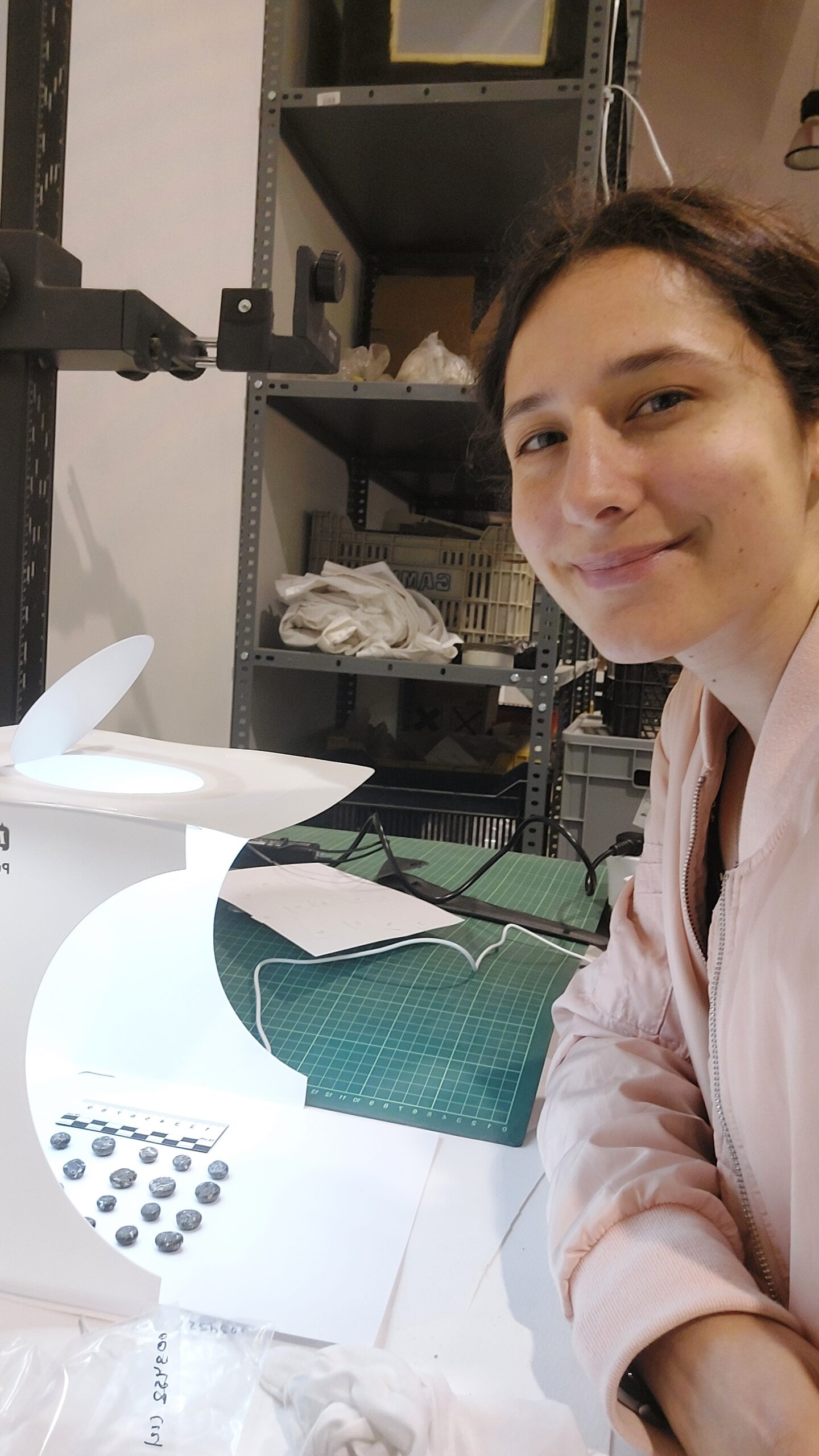
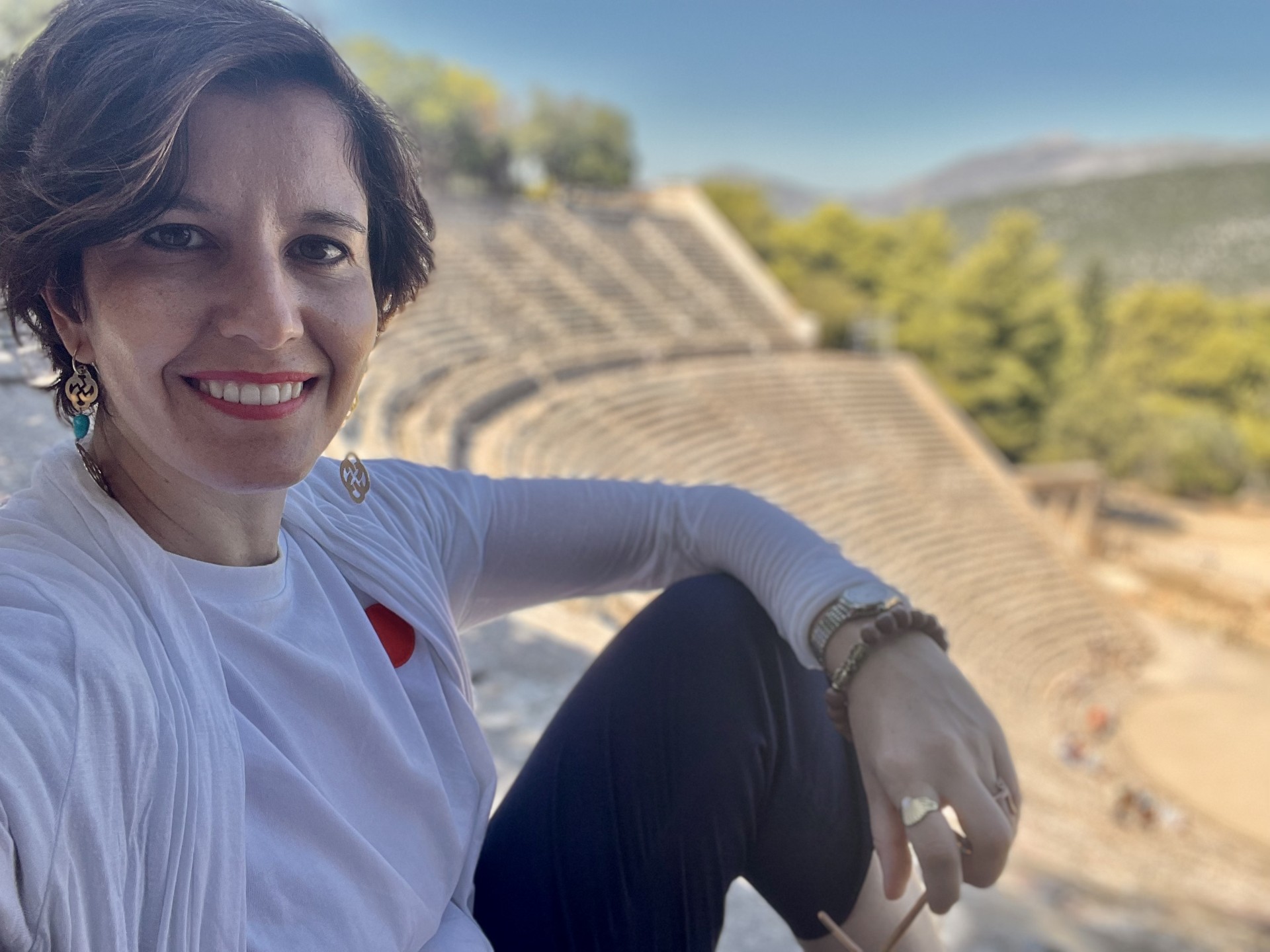
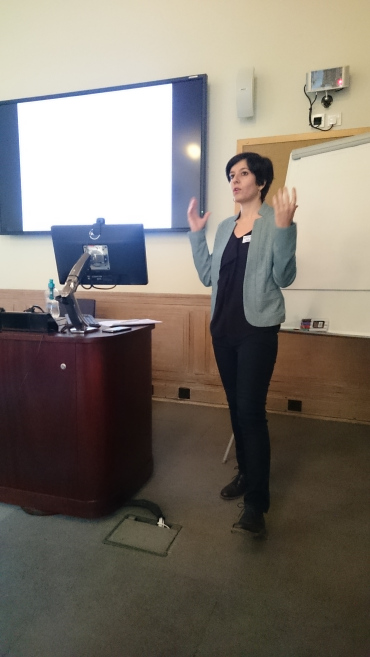
The WCC Small Grant Scheme that I received in March 2026, has allowed me to visit two archaeological museums around the Southern Valencian Community and Region of Murcia- Spain. I was already in Spain for a conference, and with the help of this additional funding I was able to book a car to get to the museums, and to stay an additional night to conduct my research. I visited the Vila Museu collection in La Vila Joyosa (Southern Valencian Community) and the Museo de Coimbra del Barranco Ancho (Jumilla – Murcia).
I was able to analyse a series of gaming items—including knucklebones, dice, glass, ceramic bone and stone counters, and gaming sets from many findspots —residential, funerary, private and public.
The investigation consisted in the graphic documentation of gaming items from local Iberian excavations, which are mostly from funerary contexts, and Roman cities. The research spans diverse centuries, which run from around the 6th century BCE up to the end of the 3rd century BCE.
The variety of the ancient settlements in the area are good examples of multicultural exchange conditions and co-existence of people in the past, since the time span of occupancy covers both the Pre-Roman/Iberian and Roman periods. By analysing the objects, I aim to investigate further and draw new conclusions about multiculturality and social aspects of the people who inhabited this land in the past.
All data – both items and related documentation—are still in the process of being analysed, but this visit has successfully served to implement my research in this geographical area.
In addition, the collaboration with the museums has served to establish a stronger scientific connection with the museum’s curators. Many of them are not experts on gaming items, and by undertaking discussions and talks, I was able to give them new tools to recognise gaming items and gaming boards within their collections. We also shared papers and books about gaming research in the area, and elsewhere, and we will remain in contact. These museums still receive many new archaeological finds from the systematic excavations or urban excavations around the cities and the district, and the curators will mind contacting me if they find new gaming data.
The analysis that will be drawn from this research will ultimately help preserving the distinctive cultural heritage of games of the Southern Valencian Community and the Region of Murcia and its varied archaeological evidence.
By Ilaria Truzzi, PhD Candidate, University of Reading
Thesis title: Playing in Ancient Iberia. The materiality of games in a multicultural context
As part of our tenth anniversary celebrations, we are writing a series of blog posts in which members tell us about their experiences with the WCC UK. Our sixth interviewee is Dr Liz Gloyn.
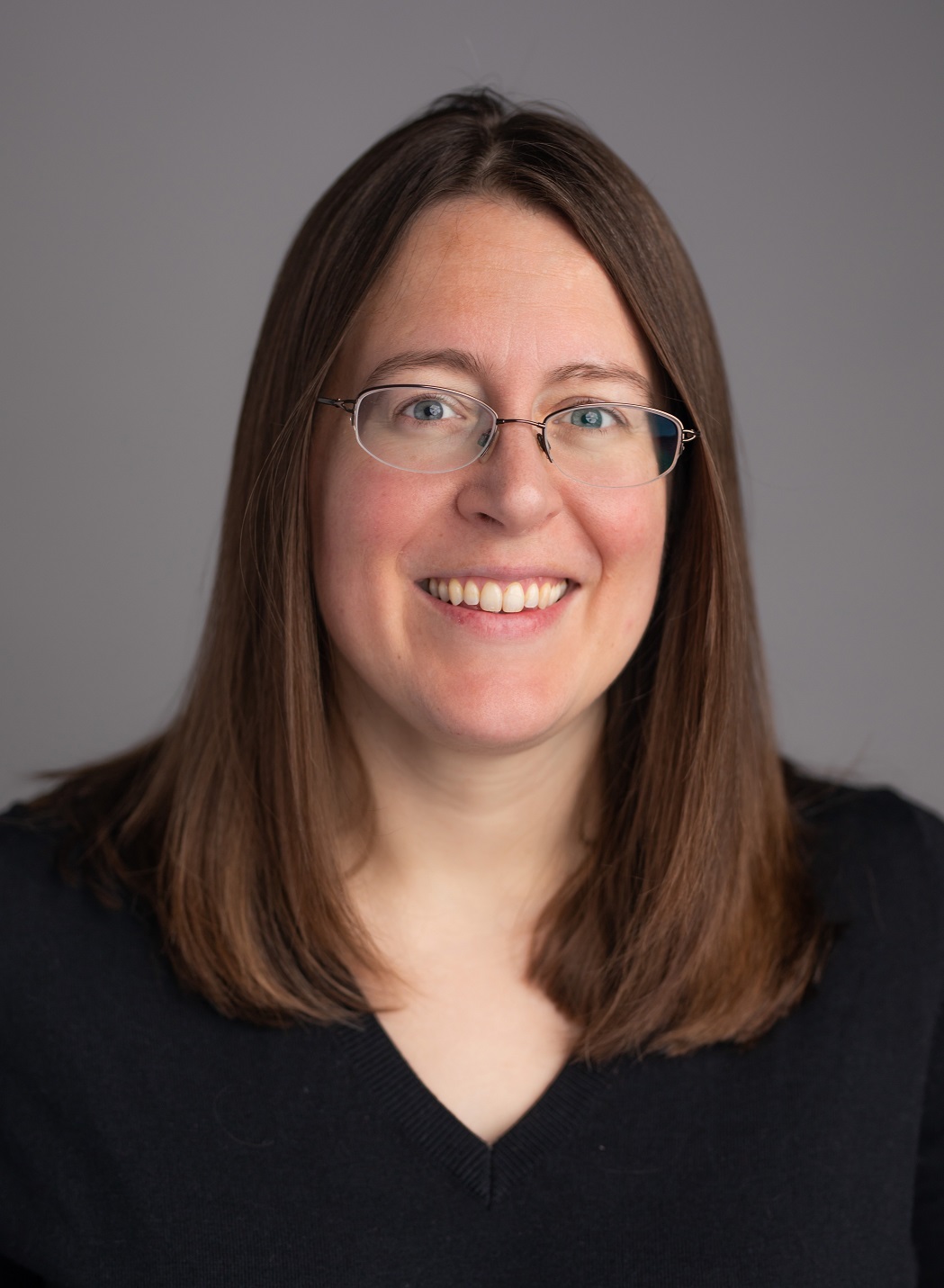
Liz Gloyn is a Reader in Language Language and Literature at Royal Holloway, University of London. Her research includes work on Seneca the Younger and his approach to the family, and she is interested in feminist approaches to Latin literature. She has also published on the reception of classics in popular culture, with a particular interest in film and children’s literature. Her blog about classics and academia is titled ‘Classically Inclined‘. She was the first Administrator of the WCC, starting in 2016.
She discusses her involvement with the WCC with Katherine McDonald, current co-chair of the WCC.
KM: So how did you first get involved with the WCC? You won’t be surprised to hear that a few of our other interviewees have mentioned you in their answer to this question.
LG: Yes, in many ways it’s my fault! I did my PhD in the US, where there had been a Women’s Classical Caucus going since the 1970s; the rise of second-wave feminism had created a kind of solidarity for women across university departments there. They’ve been going ever since and they are still doing wonderful things. I found a lot of fellowship there as a graduate student.
When I came back to the UK to a Teaching Fellowship job and knew nobody, I didn’t have any kind of connection into any networks. One of the things I found myself thinking in those early years was, ‘wouldn’t it be nice if there was a WCC in the UK?’ Because the UK, where the numbers of Classicists were smaller, had missed that moment in the 1970s.
I sat on that thought for a bit while I was a Teaching Fellow, and then I landed a three-year job at Royal Holloway, which was eventually extended to become the permanent job I’m still doing now. My colleague Efi Spentzou put on a workshop with Genevieve Liveley called the ‘Classics and the New Faces of Feminism Sandpit’. They wanted to do something exploratory and interesting around feminist scholarship and thought. I went to that, and thought to myself, ‘wouldn’t it be a good idea if we used some of the energy in this room to make a WCC UK happen?’
I was very lucky to have fantastic people commit to the project who knew a bit more about the discipline, a bit more about organisational structures, a bit more about how you make stuff work. One of the things I am very good at is organising, and there were other people who were very good at thinking about strategy and keeping activity focused on our goals.
There hadn’t been a new membership organisation formed in Classics in the UK since, I think, the incorporation of the Council of University Classics Departments. The fact that we might start a new thing was radical and I’m actually really proud that since the WCC UK started, we’ve seen a lot more groups emerge to serve other communities that are marginalised within the discipline.
KM: What WCC initiatives or events have been particularly important to you or really stick out in your memory?
LG: It’s really hard to pick out one thing, because I had a finger in pretty much everything when I was Administrator, and everything was awesome. It was amazing to have so much enthusiasm and so many different kinds of people wanting to do things.
I remember we did an event at Birmingham on feminist pedagogy, and we’ve still got the resources up on the website for it. I was really proud of that as a way of centring feminist pedagogy as something we could do within the discipline. And it was so good to see lots of early career colleagues participating in that.
I have been really proud of our AGMs, and particularly that our AGMs travelled to different places. We had one in Cardiff and colleagues really appreciated that we’d brought the event to Wales. That was wonderful.
Speaking personally now, I am grateful for the Mid-Career event which caters to colleagues who are in that weird mid-career zone, and lets us talk about all of the challenges of that moment. That event creates a repeated space for people to come back every year and share where they are, meet new folks, see familiar faces, see colleagues talk about what’s happened in the interim. Mid-Career folks don’t get very much support in academia on the whole, but that space is so important.
And finally I’m proud of the work we do behind the scenes. I’m proud that we got to be a nominating body to REF. I mean, that wasn’t on my bingo card when we started. We can really engage and make sure that REF panel has a range of voices and genuine representation of the field. I’m also proud that the WCC is an organisation that is taken seriously and moves forward agendas in all sorts of exciting different ways.
KM: What has the WCC added to your life as a woman in Classics in the UK?
LG: Having a group which has the momentum to get stuff done has mattered. It has been delightful for me to see colleagues who had felt very disempowered in other settings succeed in the WCC’s environment. Seeing people flourishing, growing, blossoming and developing in their confidence. That’s been just as lovely as the benefit I’ve had myself from being part of mentoring triads, for example.
For me personally, it’s wild to think that my idea has made such a positive difference for people over the last ten years, and has had such direct and indirect effects on the discipline. As you know, I stepped down from being Administrator a couple of years ago to focus on other things, and to see people still getting so much out of it is the most rewarding part of the whole thing. It’s become a sustainable organisation for the long term.
KM: What would you say to someone considering joining the WCC for the first time, particularly if they are a PhD student or an early career researcher?
LG: We’re excellent value! But, seriously, I would say: do not underestimate the importance of finding people who speak your language. Of finding people who understand and appreciate a feminist approach to scholarship. We have had people come to talk at our events, as graduate students at spotlight talks for example, who have been a little bit stunned by the fact that their research has been taken seriously, when they’re used to an environment which is partly or entirely hostile to their approaches and their methods.
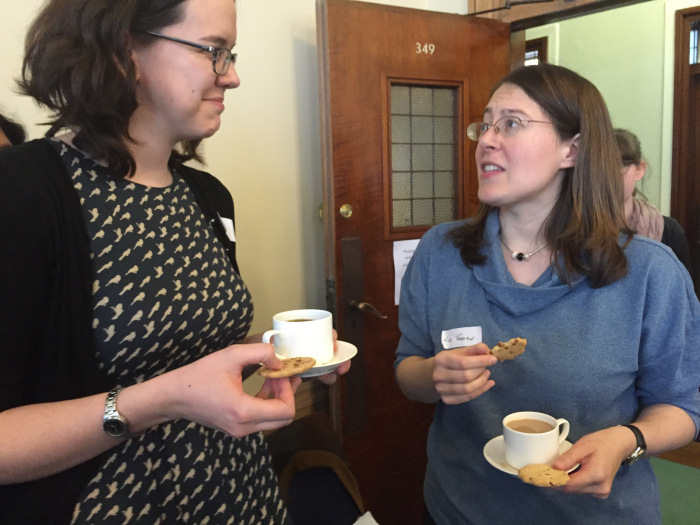
Liz Gloyn (right)Liz Gloyn at the first AGM in 2016
As part of our tenth anniversary celebrations, we are writing a series of blog posts in which members tell us about their experiences with the WCC UK. Our fifth interviewee is Dr Katerina Velentza.
She discusses her involvement with the WCC with Katherine McDonald, current co-chair of the WCC.
KM: How did you first get involved with the WCC?
KV: My involvement with WCC started in the spring of 2023 when I started my role as disability liaison. I was a WCC member though from earlier in that year, which is why I received the newsletter with the various events and opportunities including the disability liaison position opening.
KM: Which WCC initiatives or events that have been important to you?
KV: I have really enjoyed all the AGMs that I have attended. In particular the discussions related to issues of early career scholars have been very insightful. Also, the Working in Archaeology, Heritage and Classics with a Long-Term Condition events organised in 2024 and 2025 for Rare Disease Day have been really important to me because they led to meeting more people in the field who live with chronic conditions or disabilities.
KM: What has the WCC added to your life as a woman in Classics?
KV: WCC has added an amazing network of colleagues that are navigating similar issues as me in academia and Classics. In particular, through my role as disability liaison and the ‘living with a long-term condition’ events that I have been organising for Rare Disease Day, I have met many other classicists and academics who live with chronic conditions. We have created a small network or unofficial support group and meet once a year which has been really helpful.
KM: What would you say to someone considering joining the WCC for the first time?
KV: WCC is a wonderful community to join with opportunities to meet new people in the field but also seek advice and support on various issues and topics. I would really recommend joining to anyone interested no matter the stage of their career. I think the WCC is an amazing organisation to bring people together.
As part of our tenth anniversary celebrations, we are writing a series of blog posts in which members tell us about their experiences with the WCC UK. Our fourth interviewee is Dr Christine Plastow.
Christine Plastow is a Senior Lecturer in Classical Studies at the Open University. Her research focuses on Greek oratory and on the contemporary theatrical reception of Greek myth. She was the Mentoring Officer and then the Treasurer of the WCC.She discusses her involvement with the WCC with Katherine McDonald, current co-chair of the WCC.
KM: Tell me a bit more about how you first got involved with the WCC.
CP: I remember going to the launch event; I was a PhD student at the time. I was just kind of amazed that the WCC didn’t already exist that we were just launching it then.
It felt valuable to me personally because I was doing my PhD in London but I didn’t live in London for the first couple of years of my PhD, so I didn’t feel embedded in the London Classics community, which was very busy and big. I always felt kind of on the outside. The WCC gave me another community that I felt like I could be a part of.
Later, I became a bit more involved. I think I ran for steering committee and didn’t get elected, but then I volunteered to be the Mentoring Officer. At one of the AGMs we were talking about starting a mentoring scheme and I thought, that sounds like something I could do. And I did that for a couple of years before I became the Treasurer.
KM: Are there any initiatives or events that have been important to you or have been particularly memorable for you? You’ve already mentioned the mentoring scheme – is there anything you want to say about that?
CP: I really enjoyed being the Mentoring Officer, particularly establishing the Mentoring Triads. And I really enjoyed being part of a triad. I think I’ve done it three times now and I’ve always found those mentoring triads a really nice thing to do throughout the year, just to have people to check in with who are disconnected from all other aspects of my academic life. I don’t know how many people have gone through that process since it’s existed, but it’s quite a lot considering our small membership. So I was pleased to be able to set that up.
The other initiative that has been the most important to me personally was the Small Grants Scheme. So, when I became Treasurer in 2020, Carrol [Atack] had already set up the emergency grants during Covid and that in itself was really powerful. We were reading applications from people who were in quite difficult circumstances because of the pandemic and I felt I could do something material that was helping those people. That felt very meaningful to me at the time.
And then, even before the emergency grants, we have been kind of talking about a small grants scheme. After the CA started doing the admin for the emergency grants on their own, I got that set up and then ran it for the rest of the time that I was Treasurer. That was really rewarding. It felt like a real meaningful difference that the committee could make because we all know that funding is not easy to find, especially small amounts. Sometimes you only need £100, or even £50, to fund a trip to an archive or a conference. Or graduate students want to put on a one-day conference, and they just want to have some catering. So even though it would be great to be able to hand out bigger pots of money, just that £150 has enabled so many people to go to conferences or hold events that they wouldn’t have been able to otherwise, especially with departments having less and less available for ECRs.
KM: It’s still a really active and much-appreciated scheme.
CP: And I think that means we’ve had influence in a tiny way on lots of different events around the UK. Maybe the committee hasn’t always been as visible as we would have liked it to be, but I think behind the scenes, we’ve probably been doing important work. Sportula was also really inspiring for us. Because it’s a mutual aid thing, really – all the money for funding small grants always just came from membership payments or donations. Since we started doing a lot more of our events online and we weren’t spending so much money on hosting our own in-person event, it felt like a really good alternative use of that money. Just give it back to the members who need it.
KM: So you’ve talked about how you’ve helped other people through the WCC, but what has it mean for you personally?
CP: In practical terms, being the Treasurer has taught me how to be a treasurer. I’m now the treasurer of another group and it’s very easy because I’ve done it before. So it kind of gave me confidence in that kind of an administrative role. And although the WCC steering committee has always been very friendly, it has prepared me for less friendly committees!
But more than that, I think, meeting everybody that I’ve met through the WCC has been probably the most valuable thing to me. Especially because I’m at the Open University, and although we’re quite tight-knit we don’t always spend a lot of time together. Knowing there’s another network you can tap into where people have similar interests, or a similar ethos, has been important. Also, the fact that it’s UK-based, because my academic research networks are quite international. It’s important to have a network that I can rely on, whether that’s for a moan about something or a new collaboration. I can reach out to people in a professional context, because I know them through the WCC.
KM: If we don’t have an old-boy’s network, we can create our own, right?
CP: Yes, and now I’ve taken that same approach into other areas of my research, encouraging younger women to get involved in other research networks that I belong to, for example.
KM: So what would your message be to someone who is considering joining for the first time, particularly a student or an ECR?
It’s definitely worth joining, especially if you’re a student: it’s only five pounds a year. Even if you just join to be able to apply for a small grant, the five pounds is worth it. But apart from that, I would say: join and get involved in the mentoring schemes. Because being able to have short-term mentoring on a particular issue or a co-mentoring triad, it’s just so valuable to have that resource. And I think everyone who is more senior who has signed up for those schemes is so generous with their time and so willing to help more junior people.
I would also say, bring to the WCC what you want to get from the WCC. So, I would really encourage new people joining to bring ideas for events that they want to hold or initiatives that they want to set up or things that they want to see changed. The more new people get involved and the more new ideas they bring, the more the WCC is going to be able to continue evolving and continue meeting the needs of its members and meeting the moment that we’re in right now. Academia is changing all the time, the world around us is changing all the time, and we need to keep changing to keep up with that.
New people joining, and bringing some enthusiasm, and some ideas and or even some criticism, that’s all really, really welcome here. Help us to make the WCC even better and even more relevant into the future.
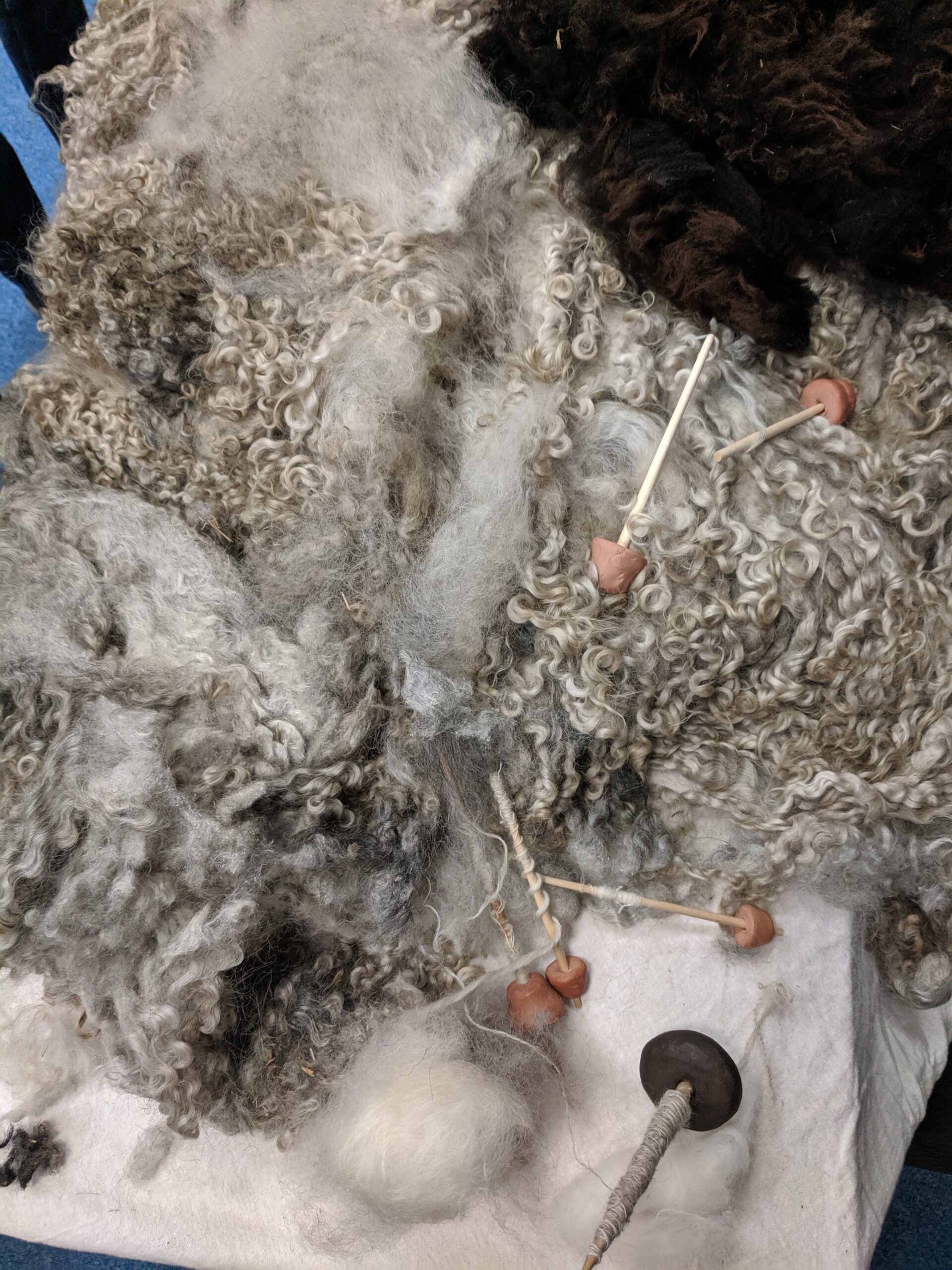
Christine kindly provided this image from the 2019 AGM, where members carded and spun their own wool.
As part of our tenth anniversary celebrations, we are writing a series of blog posts in which members tell us about their experiences with the WCC UK. Our third interviewee is Dr Carol Atack.
Carol Atack is Director of Studies in Classics at Newnham College, Cambridge. Her research deals with fourth-century BCE classical political thought, with a particular focus on the political and ethical thought of Plato and Xenophon. She was also the first Treasurer of the WCC.
She discusses her involvement with the WCC with Katherine McDonald, current co-chair of the WCC.
KM: How did you first get involved with the WCC?
CA: I met Liz Gloyn at a conference when she had just come back from her PhD at Rutgers. It was the Cambridge Triennial in 2012, which was one of those conferences that brought a lot of people together. But it was evident to us that there were lots of separate islands in the classical world, and communications between them weren’t always perfect. I went away from that event feeling that building community was really important.
Both from my research and my teaching around that time, I also got a sense that feminism itself was going in new directions, and that there were new conversations to be had. Once a group of us started talking and meeting up, it was amazing to meet so many people who were asking similar questions of different material or using the same theoretical approaches or facing similar problems.
The original meeting at Senate house [in 2016], the first kick-off meeting, was so energising, so powerful. And, yes, showed that there was lots of work to be done, and I think started to show some of the challenges that would lie ahead. Fundamentally, I think it demonstrated that there was a real need for something like the WCC to provide a space in which feminist and intersectional approaches were front and centre not marginal.
KM: Are there any other events or particular initiatives that stand out in your memory?
CA: One of the things where I think we were able to make a difference as a small organisation, which was pretty fleet of foot, was at the crisis point that emerged at the Covid shutdown at UK universities [in March 2020]. The WCC had become incredibly aware of the huge precarity of graduate funding in the UK, because it affected a lot of members. It became very clear, the minute that the Covid lockdown took hold, that a lot of partially funded and self-funded graduate students across the humanities were relying on casual work in operations that were now shutting down. So, whether that was library work, or hospitality in coffee shops and bars, or whatever, the work that was paying people’s rent evaporated. And that was a huge crisis.
But we as the WCC had money that was intended to give people small grants to go to conferences, and those conferences were not going to be happening. So there was an opportunity to repurpose events funding to provide living grants for students. And we managed to get that up and running very quickly, very straightforwardly. It was really on a kind of no questions asked basis: if somebody applied from an institutional address, then we could send them money.
That went through several rounds in the end. We were able to get the Classical Association to provide funding, and other organisations stepped in and helped or developed their own similar schemes.
Precarity of student funding remains a huge issue in the humanities, but that moment crystallised it for individuals whose very careful planning and budgeting completely collapsed.
KM: I think that’s something to be very proud of. I think if people weren’t directly involved in that, they might have no idea.
CA: We did it very quietly and we aimed not to be a burden on applicants.
One of the other things I’m proud of is that the WCC has always been an inclusive organisation. We’ve not been a single sex organisation, we have always had men as members and we have also been very clear that we are open to trans members and non-binary members. So whatever people’s sexual or gender identity is, there is a space for them if they are in support of our aims.
I think there have been some moments of profound learning along the way with different projects. There are points where one realises that one’s feminism has been naïve and not appreciated the complexities, for example in the intersection of gender and race or class. But I think the WCC did make a good call on inclusivity early on and that is really important now. And that came from listening to student and early career members. The fundamental principle of being an inclusive organisation was important.
KM: So, I think you’ve touched on some of this as you’ve talked about those initiatives. What has the WCC added to your life as a woman in Classics in particular?
CA: I think it’s given me a lot of comradeship and community. I’ve made friends through it and strengthened relationships with people working in similar areas. I’ve also learnt from people working in very different areas. I still do teach a lot in areas where feminist scholarship is really significant. I’ve had conversations that have helped me to appreciate different approaches, understand topics in different ways, and come to an appreciation of theorists whom I might have found difficult. There’s been a lot of learning as well as community.
I’ve spent most of my time in Classics in big departments where there are lots of people, and where there’s always someone else who is doing your stuff. So it’s maybe not been as extreme for me as it might be for somebody who is in a smaller department. But I really got a lot out of meeting people across the range of the profession, and seeing the kinds of ideas and questions that the early career members were coming up with.
KM: Finally, then, what would you say to someone particularly an early career scholar, or a student, who’s considering joining the WCC for the first time?
CA: It offers you another space in which you can have interesting conversations with people. Some of whom you will agree with, some of whom will challenge your views. Especially if you are working in a part of the subject that is more female-coded then you may find a wider array of useful interlocutors and people who understand the position of the work you’re doing. But obviously the WCC goes a long way beyond people who happen to work on sexuality or gender-related topics. Equally, if you’re working in a part of the subject where women and people concerned with gender equity are thinner on the ground, then it will be useful too. But fundamentally, it’s a good space in which you can come together and engage with people who might be experiencing similar things to you, and who might be looking at similar issues to you.
I think I’d also say that there were some moments of profound learning along the way with different projects and that in a way, some of our experiences in understanding intersectionality and getting that right, we had some painful learnings events that didn’t go well. Real challenges as feminism as a kind of project evolved from one phase to another, there was a lot of a lot of learning there. That was important on a research level, how are you approaching topics? When you talk about women in the ancient world, what women are you talking about? But also in understanding better the multiple forms of exclusion that operate across academia and thinking very hard about Classics as a subject and its history, and the kind of social exclusions, class or race and ethnicity as well as gender.
So I think that’s something that I have felt that, certainly while I was actively involved in the WCC, that was a journey. I think this should be a continuous learning experience.
I do think there are there are points where one realises that one’s feminism has been naive, not appreciating some of the complexities. I do also think that generally speaking because, British feminism has often been based in the labour movement and has shared both its openness and its closedness to other forms of oppression and understanding the intersection of sex and race based challenges and exclusions. I think that in a sense it’s a different journey from organisations in the US and understanding the difference between American and British feminist experience has also been an important thing to learn about.
And sometimes I think that because of all the amazing American scholars, whose work has dominated the field sometimes, the tradition or British social history and feminism haven’t quite made their way into Classics. So I think there’s a lot of learning there.
And also there were some things before WCC got going. An awareness of a need both for community and support to bring together. People who might be studying gender related topics who are kind of flung it around in different departments and might feel a bit marginalised in their own context, but might find it really powerful and useful to get together with people teaching their topics.
But also some of the challenges that still existed for women in the discipline which are kind of historical and complicated. Not always very evident from the outside. It always looks as though there are plenty of women and sometimes it might seem that there are a lot of women in the room and then, you will say hang on. What are they doing? Where are the senior people? Why isn’t this getting support? Why is this question being treated as trivial or marginal rather than being taken seriously?
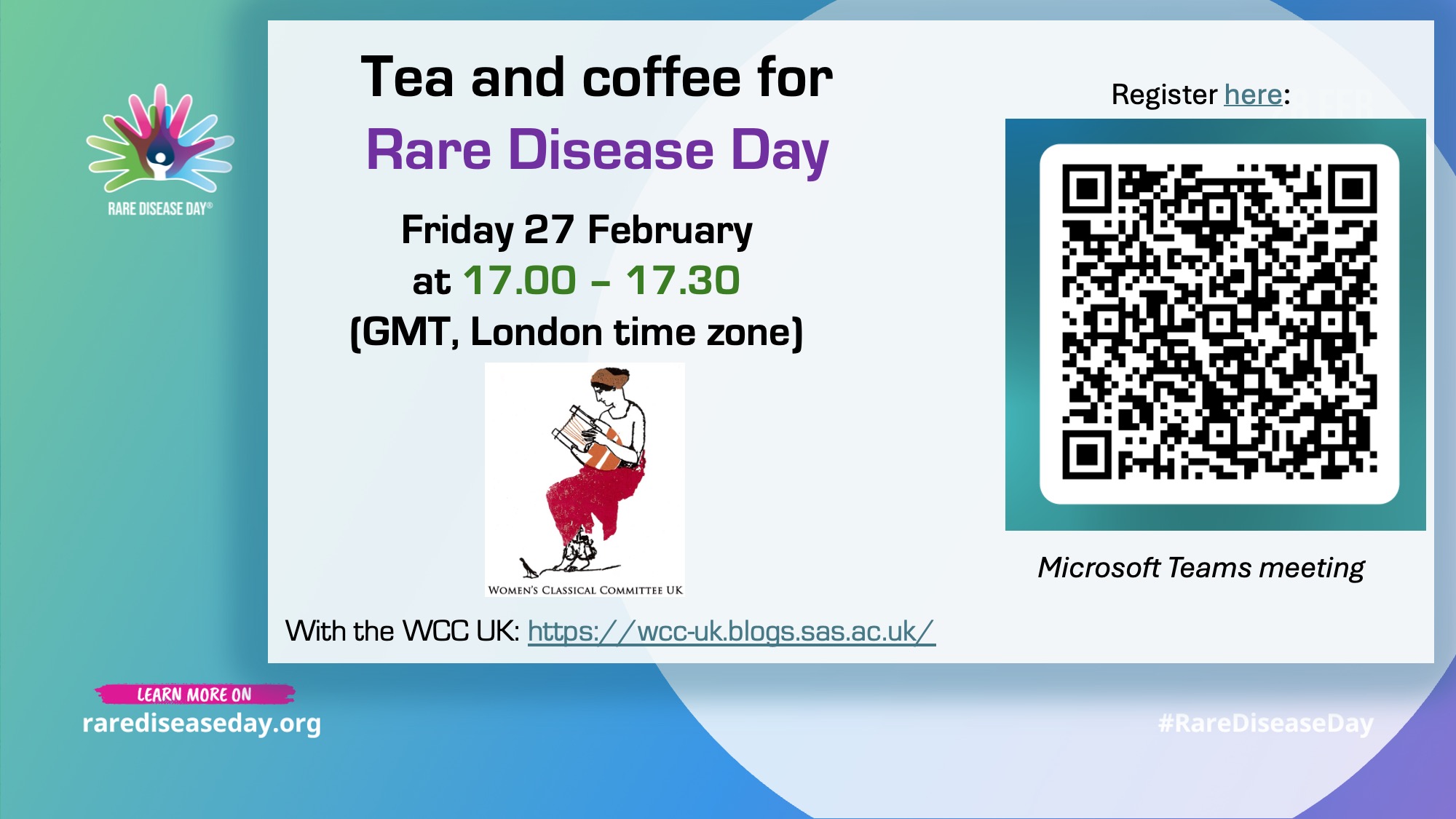
We are pleased to welcome you to an online tea and coffee break for Rare Disease Day on Friday 27th February at 17.00-17.30 GMT. A wonderful online opportunity to catch up and chat about living with long-term conditions and disability in academia.
As part of our tenth anniversary celebrations, we are writing a series of blog posts in which members tell us about their experiences with the WCC UK. Our second interviewee is Prof. Amy Russell.
Amy Russell is an Associate Professor of History and Classics at Brown. She is a Roman political and cultural historian, with a particular interest in architecture, urbanism, and space. She is a founding member and former chair of the WCC UK.
She discusses her involvement with the WCC with Katherine McDonald, current co-chair of the WCC.
KM: Tell me a bit more about how you first got involved with the WCC.
AR: You know I can’t remember exactly how I first heard about it. I’d relatively recently come back from America when this all started and I’d been a member of the WCC there. And so when I got an email saying, hey, there’s some people talking about this, I was very excited to join in. And I was one of the first people on the steering committee.
KM: So that was all about ten years ago now. In that last decade, were there any particular WCC events or initiatives that stand out to you and have been important to you?
AR: I think you’ll hear a lot of people talking about community, and I think that’s really true. Going to the in-person events was really important to me, and I’m sure online events important during the pandemic as well. But just the initial buzz around the first few in-person events, and realising, look, this is a community and we do have a real critical mass of people who are interested. And we had people willing to put in time and energy into making it all happen, and having pedagogy events, and they were really exciting people thinking about exciting things.
But I’m also very proud of the work we did behind the scenes. For example, we put in a proposal to be an official nominating body for the REF. I’m sure that there is a very strong case to be made that we should not be cooperating with the REF, but in the end it seemed to me that it’s probably better that we have a voice. So even though at the time we still felt we were very scrappy and new, we put in that application and we were successful, and then when it came time for the nominations I feel like we really did get to have a say. The Steering Committee behind the scenes were reading applications and were able to make a case for people that we thought would be good panellists, and indeed good chairs. And I am pretty proud of what we achieved. And again, with feminist activism, there’s this constant tension between working with the institutions and burning the institutions down, but sometimes working with the institutions can be a powerful tool.
KM: It’s really interesting to talk about the backstage side of it, because people often talk about an ‘old boys network’ as something that women and other marginalised people in Classics are really missing out on, and I think the opportunity to build an alternative version of that is very powerful.
AR: And one that is truly open to everyone. We had always conceptualised ourselves as being open to everyone and having a definition of ‘woman’ that was very inclusive, but also being open to people who don’t identify as women. And that was a big part of our activism from very early on. It was very surprising that there wasn’t some kind of women’s organisation already, but at the same time this was the period when organisations were springing up in different disciplines for trans people as well. Classics didn’t have any of that, at least on an official, institutional footing, and so we immediately were doing some of that work, which I see as all connected. And then, what happened at the San Diego SCS, and we did a lot of coordination of the different Classics organisations in the UK to issue a statement in reaction to that.
And another thing we were doing behind the scenes, and I’m not sure if I would do it the same way now, was contacting people who were putting together ‘manels’ and asking – would you consider making changes to your programme. I don’t know if that was the most efficacious way, but we were thinking it all through. I’ve had a lot of interesting conversations about that, then and since. And I think the guidance that we put out about manels and about hiring plans and things like that, those were good, useful documents. I hope that people have read them.
KM: So, this is all about the wider system, but is there anything you feel the WCC has really added to your life as a woman in Classics?
AR: It definitely comes back to community. These people are still people I feel very close to and work with, and can share frustrations with sometimes. When I was a graduate student, I was still only beginning to realise how bad things were. We talk lot about feminisation of the humanities, but in some places and some universities, Classics still is one of the last to go. I remember when I was doing my Master’s at Oxford, and I decided to sit in on the MSt in women’s studies, and I walked into the lecture room and I realised for the first time in my life I’d been in a room that was majority women at a lecture. Because I’d come up in this system that I’d seen as completely normal, and I’d never connected my own activism outside my work with what was going on in my own field.
K: Final question then: What would you say to anyone who is thinking of joining the WCC for the first time?
A: Well, I’d say, do it. Take advantage of this organisation that allows you to find community with people working at different kinds of institutions, with different kinds of life experiences. For me certainly it’s been incredibly helpful for me to think about, with lots of trial and error, the relationship between my own professional identity and my own activism. Certainly for anyone who is having thoughts about that, this is a great place to go.
Our call for nominations to join the Steering Committee of the Women’s Classical Committee UK is now open.
The Steering Committee runs the WCC UK, including organizing events, workshops, and future development of the WCC UK. Committee members serve for four years, with the option to renew for a further four-year term. The Steering Committee wishes to encourage a diverse organization comprised of representatives from any background, location, or career level.
If you’d like to shape our agenda, or if you have a perspective that ought to be heard, please do put your name forward. You are also welcome to nominate someone else.
People of any gender expression or identity who support the WCC UK’s aims are welcome to become members and to put themselves forward for office; our aims can be found by clicking here.
Nominees must be members of the WCC UK – but you can become a member when you’re elected, if you’re not a member already.
If you’re interested, you should submit your name (or somebody else’s) to Katherine McDonald, WCC Co-Chair, by Monday 9th March 2026. Her e-mail address is katherine.mcdonald@durham.ac.uk.
Next steps
Each nominee will be asked to send in a short statement (around 150 words) detailing why they would like to join the committee.
These statements will be made available on the WCC UK website for members to review prior to voting. If you’re nominated by somebody else, the Co-Chair will contact you for permission to place your candidacy on the ticket.
Voting will open on Monday 16th March and run until Monday 20th April 2026. The elected members will be announced at the AGM on Wednesday 22nd April 2026.
If you have any questions about the Steering Committee or the process of elections, please e-mail us at womensclassicalcommittee@gmail.com.
Liaison Officers
In addition to the Steering Committee elections, we also have a number of liaison officers for different groups. These positions are normally held for a renewable two-year term. Please get in touch with Katherine McDonald (katherine.mcdonald@durham.ac.uk) if you would be interested or if you have any questions about these positions.
As part of the Women’s Classical Committee’s tenth anniversary celebrations, we invite you to join us for a lively round table discussion and Q&A on the theme of ‘Celebrating Women in Classics’ on 22nd April 2026 at the Institute of Classical Studies, University of London. Our panellists are experts across a range of disciplines whose work offers new and different ways of celebrating the women of the ancient world, as well as the women who have studied the ancient world.
Topics will include: the impact of modern retellings of Classical myth on the study of Classical Civilization in schools (Katharine Russell), women on the Grand Tour (Dr Hardeep Dhindsa) and the use of the women of ancient myth in modern theatre on the themes of peace and war (Dr Alice König).After presentations by the speakers and a panel discussion, the audience will be welcome to ask questions and join the conversion.
This event will begin with a drinks reception from 5pm; the panel discussion will begin at 6pm.
All are welcome to this free, celebratory event. The event is in-person only, but a recording will be made available afterwards.
The evening event will be preceded by the WCC’s AGM, from 2-4pm. This is for members only, but all are welcome to join (see details below). This is in Room 264, and a link has been sent to members.
Katharine Piu San Russell is a PhD student at Durham University. Her research looks at how the recent wave of myth-based fiction by female authors is changing the classical pedagogy landscape. By interviewing students and teachers across England, she has found that this literary trend has been generating a sense of belonging for a new community of young women classicists. Her research was inspired by five years spent as the Head of Classics at a multi-academy trust in the East of England.
Dr Hardeep Dhindsa (he/him) is the Curator of Victorian Art and the Global at Birmingham Museums Trust, specialising in Greco-Roman art and its receptions. He is interested in the relationship between Whiteness and classical antiquity across the British Empire, particularly during the long eighteenth century. Hardeep has collaborated with several cultural institutions, including The British Museum, The National Trust, and The National Gallery to develop public programmes addressing the difficult histories of empire.
Prof. Alice König is a Professor of Classics at the University of St Andrews. Her current research projects, ‘Visualising War and Peace: interplay between conflict narratives in ancient and modern cultures’ and Visualising Peace, both explore the ways in which interplay between conflict narratives in different media has helped to canonise ideas about war and peace across time and space. Since 2019 she has worked with the professional theatre company NMT Automatics, including on the development of their 2022 play, ‘Tempus Fugit: Troy and Us’, more recently on a new play about peace and post-conflict recovery, provisionally titled ‘Rena’. In 2025, Alice founded the Ancient Peace Studies Network.
Supporting the WCC UK
This event is free to attend, but if you would like to support the Women’s Classical Committee UK’s work, make a donation via Paypal or join the WCC as a member.
Members of the WCC UK are eligible to join our mentoring programmes and apply for our Small Grants funding, as well as always having free access to all our events. Membership fees are £20 per calendar year, or £5 for students and unemployed, underemployed, or retired members. For more information and to join please visit our website.
Financial support for attendees
Thanks to generous funding from the Classical Association and the Council of University Classics Department’s EDI Committee, we are able to offer 7 bursaries of £100 each to enable graduate students and unemployed or underemployed attendees to participate in this event. For more information and to apply, please click here for the application form.
Members of the WCC UK can alternatively apply to our Small Grants scheme for up to £150 towards their costs in attending the AGM and/or the evening event.
Funding
We are grateful to the CUCD, the Classical Association and the John Coffin Trust Fund for their generous support for this event.
As part of our tenth anniversary celebrations, we are writing a series of blog posts in which members tell us about their experiences with the WCC UK. Our first interviewee is Dr Irene Salvo.
Irene Salvo is a Lecturer in Ancient Greek History at the University of Verona. She has been a LGBT+ activist since many years, promoting the visibility of queer identities in the field of Classics and Ancient History as well as harnessing the power of Greek and Latin sources to fight homo-transphobia through education today.
She discusses her involvement with the WCC with Katherine McDonald, current co-chair of the WCC.
KM: How did you first get involved with the WCC?
IS: Basically, I have been involved with the WCC since the very beginning. It was 2015 in London, and I participated in the sandpit on ‘Classics and Feminism’ organised by various people at the University of London. I remember Effi Spentzou was one of them. It was a way of gathering people interested in feminism in Classics and talking freely about research ideas and teaching plans. And at that meeting, if I remember correctly, Liz Gloyn raised her hand and said, ‘Why don’t we have a WCC like in the US here in the UK?’ And her idea proved very successful, because from that point on the wheels were in motion, and so the WCC UK came to life. I was very much involved in the initial discussions about the format; I remember our discussions about the name and what we should call ourselves.
At the time, I was a postdoc at Royal Holloway. And it was very liberating to participate to share this energy. Because I had been feeling that something was missing in UK academia, and in general in Europe. Because certainly there was the EuGeSta network (European Gender Studies in Antiquity), but that was very much research-based; these days they also have projects on gender and Classical scholarship that aims to give visibility to the work of women in Classics. But the way in which the WCC differentiated itself from existing networks – such as EuGeSta and Arachne (Nordic Network for Women’s History and Gender Studies in Antiquity) – was firstly the geography, because it was UK-based, and secondly its comprehensive approach, which included research, teaching and especially activism. And this was very inspiring to me and reflected what I wanted to do as an academic: not just being a solitary researcher but really becoming a rounded intellectual who was engaging with what was happening in society.
KM: In the last ten years, have there been any particular initiatives that have been really important to you, or any events that have been really inspiring?
IS: Certainly the initiatives for early career scholars, and also the initiatives that I organised myself as LGBT+ liaison officer from 2015-2021. There was an important workshop which took place in February 2018 at the University of Reading. It was co-organised with Katherine Harloe and Talitha Keary, and it was about teaching, research and activism in LGBT+ Classics. And so it was a great platform to showcase how we could make the queer component of the Classical curriculum more visible, not just in teaching but also in research and in public engagement.
But I also found it very important to be able to sponsor WCC panels at the CA. I co-organised a panel for the CA [Swansea, 2020] together with Maria Gerolemou on “Storying Gendered Emotions in Classical Antiquity”. Unfortunately, it was right in the middle of COVID, and so it was cancelled at the time, but the good thing was that we continued working on it and it came out as a journal issue for the Journal of Cognitive Historiography [in 2024]. So I mention this as a way of showing how the WCC can be a promoter of research and research outputs.
KM: Yes, and bringing people together who can collaborate on that research as well.
IS: Yes – and although anyone of any gender was welcome to contribute to that panel, in the end it was an all-female line-up. And I think that it is still important to care about women being on panels. I always found it very stimulating the discussions that we had about spotting all-male panels which, astonishingly, are still commonly happening. Especially in the UK, the WCC has been a sort of guardian, keeping an eye on this kind of practice, and naming and shaming those scholars who are still actively excluding women from research activities.
KM: And providing alternative opportunities as well, that’s been so important. The next question – and you’ve partially answered this already – is, what do you feel the WCC has added to your life and your experience of being a woman in Classics?
IS: The WCC helped me to understand that we have a purpose, not just in academia, but in society, to bring about positive change. I think that this is one of the lessons I’ve learned in the WCC, that thanks to community and solidarity among like-minded people, we can be agents of change. And it was tangible change, you could really see that the discussions that we had online, and in meetings, we were really bringing about change in the way that Classics as a discipline was performed in UK academia.
KM: I completely agree. So, what would you say to someone considering joining the WCC for the first time, particularly students and ECRs?
IS: I think that PhD students and ECRs getting involved can find mentors, and inspiring role models. First of all, they can find fresh ways of being a Classicist. Classics is a very traditional discipline, but the WCC has a plethora of women who have reached good positions, in great jobs, by doing Classics in very original and innovative ways. And also many senior members of the WCC are not just researchers but also very engaged and committed educators. They are putting forward various kinds of engagement projects, and are very committed to engaging with society at large, so I think that they can offer role models about how to be a better Classicist.
And secondly the WCC offers a network, a support network, a community that can really pick you up when you are feeling low. And it’s a non-judgemental space. I think this is the greatest thing in the WCC UK. You can come as you are, with your fragilities, with your doubts, and you will always find a sense of community that embraces you and supports you and leads you to a better phase of your life. So, I think these two things – finding role models and finding a community – are two of the biggest merits of the WCC UK.
We use cookies to ensure that we give you the best experience on our website. If you continue to use this site we will assume that you are happy with it.