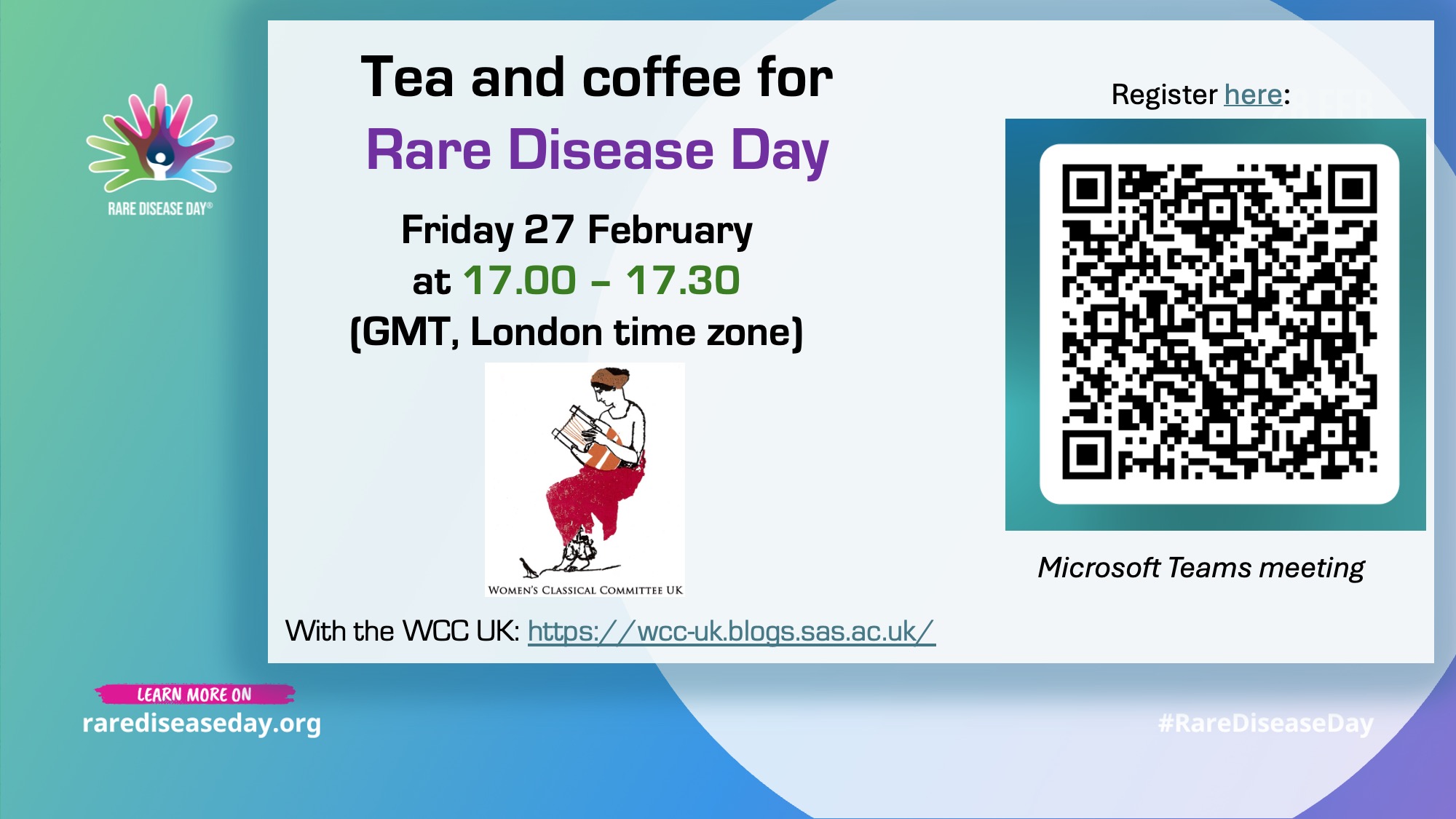
We are pleased to welcome you to an online tea and coffee break for Rare Disease Day on Friday 27th February at 17.00-17.30 GMT. A wonderful online opportunity to catch up and chat about living with long-term conditions and disability in academia.
As part of the Women’s Classical Committee’s tenth anniversary celebrations, we invite you to join us for a lively round table discussion and Q&A on the theme of ‘Celebrating Women in Classics’ on 22nd April 2026 at the Institute of Classical Studies, University of London. Our panellists are experts across a range of disciplines whose work offers new and different ways of celebrating the women of the ancient world, as well as the women who have studied the ancient world.
Topics will include: the impact of modern retellings of Classical myth on the study of Classical Civilization in schools (Katharine Russell), women on the Grand Tour (Dr Hardeep Dhindsa) and the use of the women of ancient myth in modern theatre on the themes of peace and war (Dr Alice König).After presentations by the speakers and a panel discussion, the audience will be welcome to ask questions and join the conversion.
This event will begin with a drinks reception from 5pm; the panel discussion will begin at 6pm.
All are welcome to this free, celebratory event. The event is in-person only, but a recording will be made available afterwards.
The evening event will be preceded by the WCC’s AGM, from 2-4pm. This is for members only, but all are welcome to join (see details below).
Katharine Piu San Russell is a PhD student at Durham University. Her research looks at how the recent wave of myth-based fiction by female authors is changing the classical pedagogy landscape. By interviewing students and teachers across England, she has found that this literary trend has been generating a sense of belonging for a new community of young women classicists. Her research was inspired by five years spent as the Head of Classics at a multi-academy trust in the East of England.
Dr Hardeep Dhindsa (he/him) is the Curator of Victorian Art and the Global at Birmingham Museums Trust, specialising in Greco-Roman art and its receptions. He is interested in the relationship between Whiteness and classical antiquity across the British Empire, particularly during the long eighteenth century. Hardeep has collaborated with several cultural institutions, including The British Museum, The National Trust, and The National Gallery to develop public programmes addressing the difficult histories of empire.
Prof. Alice König is a Professor of Classics at the University of St Andrews. Her current research projects, ‘Visualising War and Peace: interplay between conflict narratives in ancient and modern cultures’ and Visualising Peace, both explore the ways in which interplay between conflict narratives in different media has helped to canonise ideas about war and peace across time and space. Since 2019 she has worked with the professional theatre company NMT Automatics, including on the development of their 2022 play, ‘Tempus Fugit: Troy and Us’, more recently on a new play about peace and post-conflict recovery, provisionally titled ‘Rena’. In 2025, Alice founded the Ancient Peace Studies Network.
Supporting the WCC UK
This event is free to attend, but if you would like to support the Women’s Classical Committee UK’s work, make a donation via Paypal or join the WCC as a member.
Members of the WCC UK are eligible to join our mentoring programmes and apply for our Small Grants funding, as well as always having free access to all our events. Membership fees are £20 per calendar year, or £5 for students and unemployed, underemployed, or retired members. For more information and to join please visit our website.
Financial support for attendees
Thanks to generous funding from the Classical Association and the Council of University Classics Department’s EDI Committee, we are able to offer 7 bursaries of £100 each to enable graduate students and unemployed or underemployed attendees to participate in this event. For more information and to apply, please click here for the application form.
Members of the WCC UK can alternatively apply to our Small Grants scheme for up to £150 towards their costs in attending the AGM and/or the evening event.
Funding
We are grateful to the CUCD, the Classical Association and the John Coffin Trust Fund for their generous support for this event.
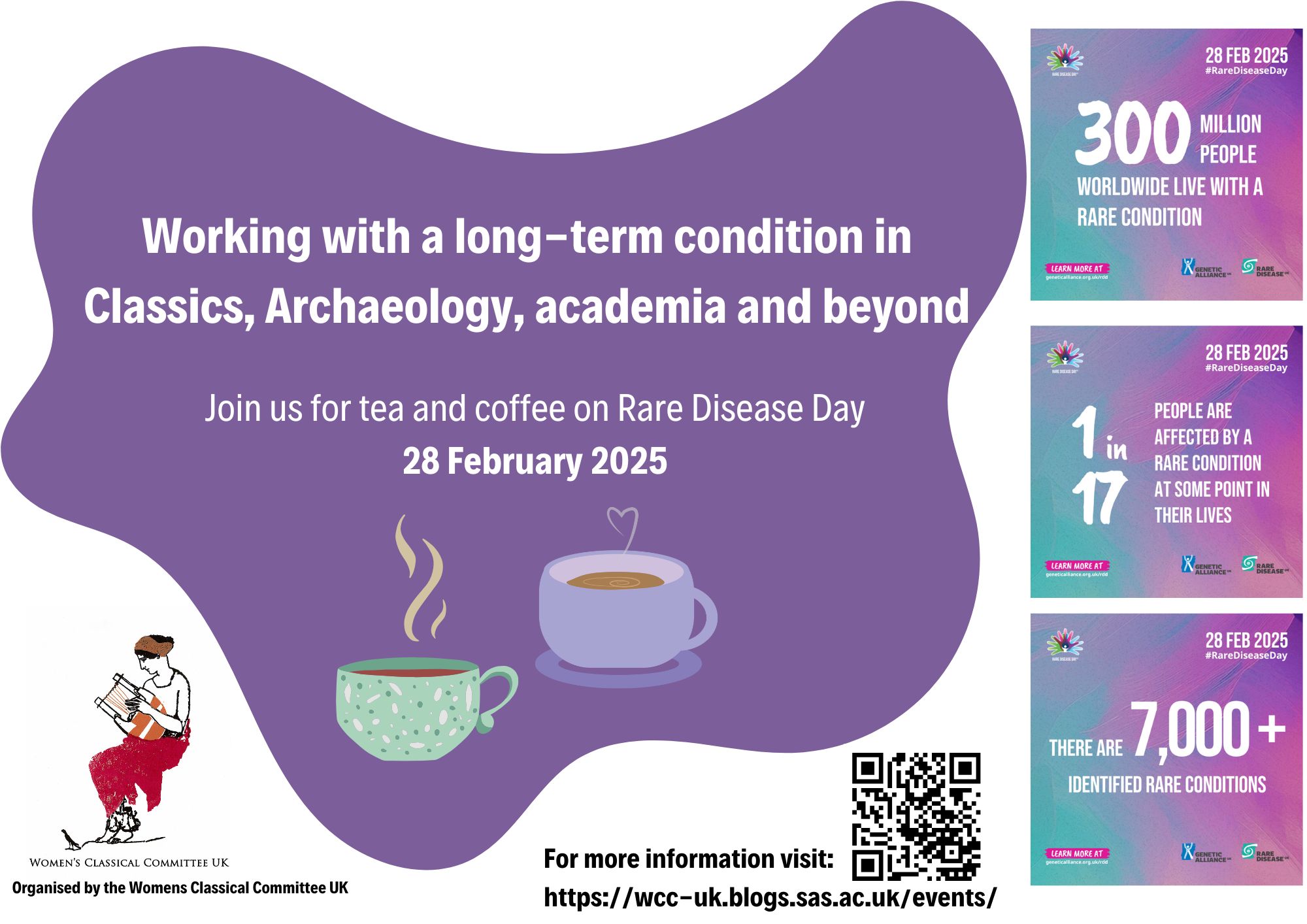
The WCC UK is delighted to host its second online networking event on ‘Working with a long-term condition in Classics, Archaeology, academia and beyond’.
The event will take place on 28 February 2025, at 15.00 – 16.00 (GMT).
Join us for tea and coffee in another networking event on this year’s ‘Rare Disease Day’
Programme
15.00 – 15.05: Welcome
15.05 – 15.15: Katerina Velentza (University of Hull)
15.15 – 15.25: Stephanie Dennie (University of Alberta)
15.25 – 15.40: Sharing challenges
15.40 – 15.55: Sharing achievements
15.55 – 16.00: Additional discussion
This networking event is seen as a safe space for people living with LTCs to share their experiences, concerns, and successes. But everyone is welcome, and we would love to have people who would simply want to raise awareness on ‘Rare Disease Day’ and learn more about how to best support individuals living with long-term conditions.
29 February 2024 (‘Rare Disease Day’), at 16.00 – 17.15 (GMT)
This ‘Rare Disease Day’ we would like to invite you to the online workshop ‘Working in Archaeology, Heritage and Classics with a Long-Term Condition’.
A long-term condition (LTC) is defined as a condition that cannot, at present, be cured but is controlled by medication and/or other treatment/therapies.
LTCs have a large impact on a person’s life. Therefore, individuals require ongoing care and support.
In this workshop three speakers will present their experiences of living with LTCs and working in archaeology, heritage and Classics. Subsequently, there will be a discussion where participants will have the opportunity to share their own experiences and problems, but also ask questions to the group.
The workshop is meant to be a safe space for people living with LTCs to share their experiences, concerns, and successes, but also for people who would simply want to learn more about how to best support individuals with LTCs in the archaeology, heritage and Classics sector.
From this event we hope to create an informal support group that people with LTCs can turn to for advice or simply sharing experiences and issues related to LTCs and their working life.
Programme
16.00-16.15: Introduction by Katerina Velentza (WCC UK Disability Liaison)
16.15-16.30: Alexandra F. Morris (University of Lincoln & University of Nottingham)
16.30-16.45: Amanda Hart (Roman Baths and Pump Room)
After an absence, the annual WCC ECR/PhD event is back, and we are excited to announce that this year’s theme – broadly – is ‘niches’. ‘Niche’ is a versatile concept, which refers to something that is ‘exclusive’ or ‘narrow’, but also the ‘place or position suited or intended for the character, capabilities, status of a person’; ‘a place of retreat or refuge’; and ‘the actual or potential position of an organism within a particular ecosystem’.
This event is an opportunity to identify, develop and articulate your research ‘niche’ in a variety of contexts. The day will be a combination of plenary roundtables and breakout groups, structured around working on self-presentation and career planning, from your ‘elevator pitch’ to your five-year plan, to approaching career or employment breaks. These informal group discussions will be a chance to explore and develop ideas with fellow ECRs, and participants are encouraged to be involved within these groups in whichever way they are most comfortable. In addition, there will be space to socialise online and form connections with other ECRs and PhD students in a more unstructured way. Attendees will have the opportunity to prepare for the breakout sessions, using planning sheets that will be sent out in advance.
The event will take place on the afternoon of the 14th July 2022. A more detailed schedule will be presented nearer the time. Attendees are welcome to attend the entire event or to drop in for specific section/s.
WCC UK are delighted to be collaborating with the Institute of Classical Studies, the Journal of Hellenic Studies, the Journal of Roman Studies and Britannia on this event about publishing articles in these journals. The workshop will take place on Friday 6th May at 10am-12pm.
This online event, hosted by the ICS and WCC-UK, is intended to demystify the process of submitting an article to some of the leading Classical Studies journals. The Editors of the Journal of Hellenic Studies (Lin Foxhall), Britannia (Will Bowden), and the Journal of Roman Studies (Peter Thonemann) will speak about the kinds of things they are looking for in submissions, the peer review process, and ways of maximising your chances of a successful submission. As well as providing a forum for the editors to speak and answer questions about their journals, the event will also be an opportunity for the Journal Editors to get feedback from the subject community about their journals and their image, and to better understand some of the challenges or barriers that potential contributors feel they face.
The event is targeted particularly at women, non-binary people and people of other marginalised genders, and early career researchers, though others are of course most welcome to attend.
The Women’s Classical Committee UK is pleased to announce its 2022 Annual General Meeting, ‘Activism‘, on Friday 29th April 2022. The AGM will be held via Zoom: please register for the event on Eventbrite and you will be sent details of how to join the meeting.
People of any gender expression or identity who support the WCC UK’s aims are welcome to attend this event. Further details are available here. Around the website you can also find more information on the Women’s Classical Committee UK, including our aims and activities and how to join.
Schedule
9.15am: Room opens; welcome and housekeeping.
9.30am: Business meeting
10.30am: Coffee break
11am: Keynote round table on meaningful activism.
The panel will include participants from Trans in Classics, London Classicists of Colour, the Network for Working Class Classicists, WCC US, and Asterion.
12pm: Lunch
1pm: Spotlight talks
Efi Spentzou – The Myth and Voice Initiative
Cheryl Morgan – Trans Men in Labour
Kirsty Harrod – Approaching A Theory of Rape Narratives in Greek Tragedy
1.50pm: Screen break
2pm: Break-out discussion rooms on the theme of activism. Each group will be given the same prompts to begin discussion.
3pm: Wrap-up and close
Spotlight talks – call for papers – deadline passed
We are reserving time during the day’s schedule for a series of short (five-minute) spotlight talks by delegates. Through this session, we hope to provide a chance for delegates to share projects, experiences or research connected to the WCC UK’s aims. We are particularly interested in talks that address the AGM’s theme of activism; that highlight new, feminist, intersectional and gender-informed work in Classics, ancient history, classical reception or pedagogy (inside and outside the university sector); and that feature new work by postgraduate students and early career researchers. If you would like more information or to volunteer to give one of these talks, please e-mail Liz Gloyn (liz.gloyn at rhul.ac.uk). The deadline for expressing interest was noon on Thursday 14th April.
Please feel free to pass on this CFP to anyone you think may be interested in participating or saving the date.
Child-friendly policy
The Women’s Classical Committee UK is committed to making our events as inclusive as possible, and recognises that the financial and practical challenges of childcare often impede people from participating in workshops and conferences. Anyone who needs to bring a dependent child or children with them in order to participate in one of our events is usually welcome to do so, but we ask you to inform us of this in advance so that we can take them into account in our event planning and risk assessment. The safety and well-being of any children brought to our events remain at all times the responsibility of the parent or carer. While we do our best to ensure that rest and changing facilities are available for those who may need them, this will depend on the individual venue we are using. Again, please contact us in advance to discuss your needs, and we will do our best to accommodate them.
The Women’s Classical Committee UK invites proposals for a seminar series aimed at late-stage PhDs and early career academics (self defined), to run online on Tuesdays at 5 pm (GMT) on Zoom throughout October and November 2021.
The theme for this- year’s WCC UK ECR event is ‘Niches’. ‘Niche’ is a versatile and productive concept, which refers to something that is ‘exclusive’ or narrow’; but also the ‘place or position suited or intended for the character, capabilities, status of a person’; ‘a place of retreat or refuge’; and ‘the actual or potential position of an organism within a particular ecosystem’. This seminar series will provide an opportunity for late-stage PhDs and ECRs (self-defined) to develop and celebrate their ‘niche’ – an original research topic, a space, a community – that allows them to be distinctive whilst at the same time fitting into, and influencing, the scholarly ecosystem.
Speakers will have the opportunity to present their work-in-progress research and articulate their ‘“niche’” in the format and length that they prefer (thesis abstract, book proposal overviews, chapter, article) within a friendly, inclusive, and informal environment, where they will receive feedback from fellow postgraduates and ECRs. Discussion will continue on a dedicated Discord channel, which will be moderated by the WCC ECR committee members, and will give speakers and attendees the chance to carry on sharing research ideas and suggestions.
All seminars will be online and papers will be between 20 and 40 minutes; they will commence on 5th October. Those who would like to present a paper should send an anonymised abstract of 300 words by September 3rd to ellie.roberts[a]sas.ac.uk. Acceptances will be sent out by September 17th.
As part of this event, we will have one session dedicated to spotlight talks of roughly 5-10 minutes. We welcome titles and a brief explanation of the material to be presented by interested researchers at master’s level and up to be submitted by September 3rd.
The Women’s Classical Committee UK is pleased to announce its 2021 Annual General Meeting, ‘Care and Caring‘, on Friday 14th May 2021. The AGM will be held via Zoom: please register for the event on Eventbrite and you will be sent details of how to join the meeting.
People of any gender expression or identity who support the WCC’s aims are welcome to attend this event. Further details are available here. Around the website you can also find more information on the Women’s Classical Committee UK, including our aims and activities and how to join.
Schedule
9.15am: Room opens; welcome and housekeeping.
9.30am: Business meeting
10.30am: Coffee break
11am: Keynote – Véronique Dasen (University of Fribourg) – “Amulets and Women’s Agency: Heracles and Omphale, a Knotted Life”.
12pm: Lunch
1pm: Spotlight talks
Lenia Kouneni – (Re)Introducing Greek embroidery in Classical Reception studies.
Jennifer Stager – Towards an archaeology of care
Helen Tank – Motherhood as a colonised concept: an ancient perspective
1.50pm: Screen break
2pm: Break-out discussion rooms on the theme of care. Each group will be given the same prompts to begin discussion.
3pm: Wrap-up and close
Spotlight talks – call for papers – now closed
We are reserving time during the day’s schedule for a series of short (five-minute) spotlight talks by delegates. Through this session, we hope to provide a chance for delegates to share projects, experiences or research connected to the WCC UK’s aims. We are particularly interested in talks that address the AGM’s theme of care and caring; that highlight new, feminist, intersectional and gender-informed work in Classics, ancient history, classical reception or pedagogy (inside and outside the university sector); and that feature new work by postgraduate students and early-career researchers. If you would like more information or to volunteer to give one of these talks, please e-mail Liz Gloyn (liz.gloyn at rhul.ac.uk). The deadline for expressing interest was 5pm on Monday 3rd May.
Please feel free to pass on this CFP to anyone you think may be interested in participating or saving the date.
Child-friendly policy
The Women’s Classical Committee UK is committed to making our events as inclusive as possible, and recognises that the financial and practical challenges of childcare often impede people from participating in workshops and conferences. Anyone who needs to bring a dependent child or children with them in order to participate in one of our events is usually welcome to do so, but we ask you to inform us of this in advance so that we can take them into account in our event planning and risk assessment. The safety and well-being of any children brought to our events remain at all times the responsibility of the parent or carer. While we do our best to ensure that rest and changing facilities are available for those who may need them, this will depend on the individual venue we are using. Again, please contact us in advance to discuss your needs, and we will do our best to accommodate them.
The Women’s Classical Committee UK is organising an event aimed at mid-career scholars, to be held on Thursday 7th January 2021 on Zoom. We anticipate that the event will run from 10am to 1pm; should national lockdowns or other circumstances intervene, we will liaise with registered attendees to establish the most convenient alternative timing on that day.
The Women’s Classical Committee UK run a mid-career event annually to help colleagues in open-ended employment discuss the issues and challenges that face academics, particularly women, at mid-career. Topics to be discussed may include decisions about whether and when to move institutions, questions around disciplinarity/interdisciplinarity and collaboration in research, expectations about international mobility and balancing this with family/caring duties, managing institutional expectations (which may be gendered) around types and levels of administrative service, taking on leadership positions, ways of supporting precarious colleagues, and strategies to tackle unconscious bias in the workplace. We anticipate that any discussion will inevitably include consideration of how the COVID-19 pandemic is affecting all these issues. Those who register their intent to attend will be invited to fill in an online questionnaire, the results of which will inform the precise choice of topics for discussion sessions. We envisage that the day’s discussions will help to set priorities for resource development and future campaigns by the Women’s Classical Committee UK.
The WCC UK recognises that the term ‘mid-career’ is open to a range of interpretations, but also that different challenges face women in classics in different situations and career stages. This event is aimed primarily at women who self-define as having reached mid-career; markers of this may include being eight or more years after the award of their PhD, holding an open-ended contract, and having an established publication profile. If the event is oversubscribed then we will give priority to women in this situation, but we welcome applications to register from anyone of any gender who feels they would benefit from attending.
The Women’s Classical Committee is committed to making our events as inclusive as possible, and recognises that the financial and practical challenges of childcare often impede people from participating in workshops and conferences. We welcome the virtual attendance of children at this event.
We use cookies to ensure that we give you the best experience on our website. If you continue to use this site we will assume that you are happy with it.