Our Etsy shop
by laurencet
The WCC UK now has an Etsy shop, with lovely merchandise. Purchases help us in financing our Small Grants Scheme.




by laurencet
The WCC UK now has an Etsy shop, with lovely merchandise. Purchases help us in financing our Small Grants Scheme.
by laurencet
Following a unanimous vote at the 2025 AGM, the Women’s Classical Committee UK wishes to reiterate its unwavering support for trans and non-binary people. We are deeply concerned at the harmful implications of the Supreme Court Ruling of 16 April 2025, the subsequent EHRC guidance, and the unfolding implementation of this guidance across educational and government institutions during the past six months.
Since its inception in 2015, the WCC has been a trans-inclusive organisation, which welcomes people of all genders as members and participants in our events and initiatives. Two of our key stated aims as an organisation are:
By ‘women’ we include, and have always included, all those who self-define as women, including (if they wish) those with complex gender identities which include ‘woman’, and those who experience oppression as women.
We reject the reduction of womanhood to a narrow definition of biology, and find this policing of gender identity and sexuality antithetical to our aims, both in our scholarship and in our activism.
We are shocked and saddened that trans and non-binary people in our field are facing ever more hostility and difficulty in going about their daily lives. We find the current direction of travel in our national institutions unacceptable, and we recognise the ever-growing barriers that many of our colleagues face as a result of living in a country which is increasingly hostile to their gender identity and expression.
We wish to restate our conviction that people of any gender expression or identity who support our aims are welcome to attend events, become members and to put themselves forward for office. We prioritise holding our events in spaces that are inclusive and do not police public spaces such as toilets and changing rooms.
We also encourage cis women to sign the ‘Not in Our Name’ petition, supported by the Good Law Project, which rejects the premise that trans women are a threat and calls on the women of the UK to stand together against discrimination (https://notinourname.org.uk).
As ever, we will continue to raise up the voices of our members, and all women, non-binary people and people of other marginalised genders in classics.
Signed,
WCC Steering Committee 2025
We thank Cheryl Morgan for her advice and guidance on this statement. “Nothing about us, without us.”
by laurencet
By Helen Van Noorden, Mentoring Liaison
This year there were over twenty requests for mentoring when the WCC UK offered one-off mentoring chats to coincide with the Classical Association Annual Conference. With the kind assistance of committee members and willingness on the part of mentors to take on two mentees, we managed to meet the demand with a variety of in-person and online appointments over that conference weekend. Mentees were roughly matched to mentors where possible in their subject interests.
Topics on which advice was requested by several mentees, other than discussions on dealing with specific forms of data, included: navigating male-dominated faculties; opportunities for those with interdisciplinary backgrounds and non-Classics-but-related majors; networking; active engagement with the academic community; perspectives on the UK academic landscape; how to choose research topics or supervisors; strategic preparation for post-PhD life.
The WCC UK offers to members both short-term mentoring at/alongside the Classical Association conference every year, and longer-term (one year) peer-mentoring in the form of one-year triads. These are set up each autumn and are expected to adhere to the WCC mentoring code of conduct.
by laurencet
Our call for nominations to join the Steering Committee of the Women’s Classical Committee UK is now open.
The Steering Committee runs the WCC UK, including organizing events, workshops, and future development of the WCC UK. Committee members serve for four years, with the option to renew for a further four-year term. The Steering Committee wishes to encourage a diverse organization comprised of representatives from any background, location, or career level.
If you’d like to shape our agenda, or if you have a perspective that ought to be heard, please do put your name forward. You are also welcome to nominate someone else.
People of any gender expression or identity who support the WCC UK’s aims are welcome to become members and to put themselves forward for office; our aims can be found at https://wcc-uk.blogs.sas.ac.uk.
Nominees must be members of the WCC UK – but you can become a member when you’re elected, if you’re not a member already.
If you’re interested, you should submit your name (or somebody else’s) to Laura Donati, WCC Co-Chair, by Thursday April 10th 2025. Her e-mail address is ldonati@liverpool.ac.uk.
Next steps
Each nominee will be asked to send in a short statement (around 150 words) detailing why they would like to join the committee.
These statements will be made available on the WCC UK website for members to review prior to voting. If you’re nominated by somebody else, the Co-Chair will contact you for permission to place your candidacy on the ticket.
Voting will open on Monday 14th April and run until Thursday 1st May 2025. The elected members will be announced at the AGM on Friday 2nd May 2025.
If you have any questions about the Steering Committee or the process of elections, please e-mail us at womensclassicalcommittee@gmail.com.
by laurencet
Since 2022, the WCC UK has run its Small Grants Scheme for members. The Scheme grew out of our Emergency Grants scheme, established by our founding Treasurer Carol Atack to support colleagues in need during the COVID-19 crisis. After we came out of lockdown, many members of the Classics community were still in financial need, and funding for postgraduate and early career students in particular became increasingly difficult to find in the current financial landscape of Higher Education. So we founded the Small Grants Scheme, to continue putting our modest funds to good use.
The Scheme pays out grants of up to £150 to support members’ academic activities, including the costs of attending academic events (transport, accommodation, caring costs etc), putting on events (room hire, fees etc), or conducting research (travel to sites, book purchases, copying costs etc). The Scheme runs a simple application process, turns applications around quickly and does not require submission of receipts or reports, to keep the funding as accessible as possible. For the past two years we’ve paid out over £1000 a year to our members, often to postgraduate and early career colleagues, which has allowed them to continue to participate in research and the Classics community with less financial pressure.
We receive no regular funding apart from membership fees, which also cover our in-person events and other expenses. We want to continue to be able to offer small grants to our members for years to come. For that reason, we’re asking for donations from our community to build up a fund for the Scheme. You can use the link below to make a one-off donation or set up a regular gift, using PayPal or a credit or debit card. All donations will go directly towards supporting the Small Grants Scheme – that is, they will go right back into the Classics community.
Click here to make a donation. We’re so grateful for your support!
If you have any questions about your donation or the Small Grants Scheme, please email the WCC UK Treasurer, Christine Plastow, at christine.plastow [at] open.ac.uk.
by laurencet
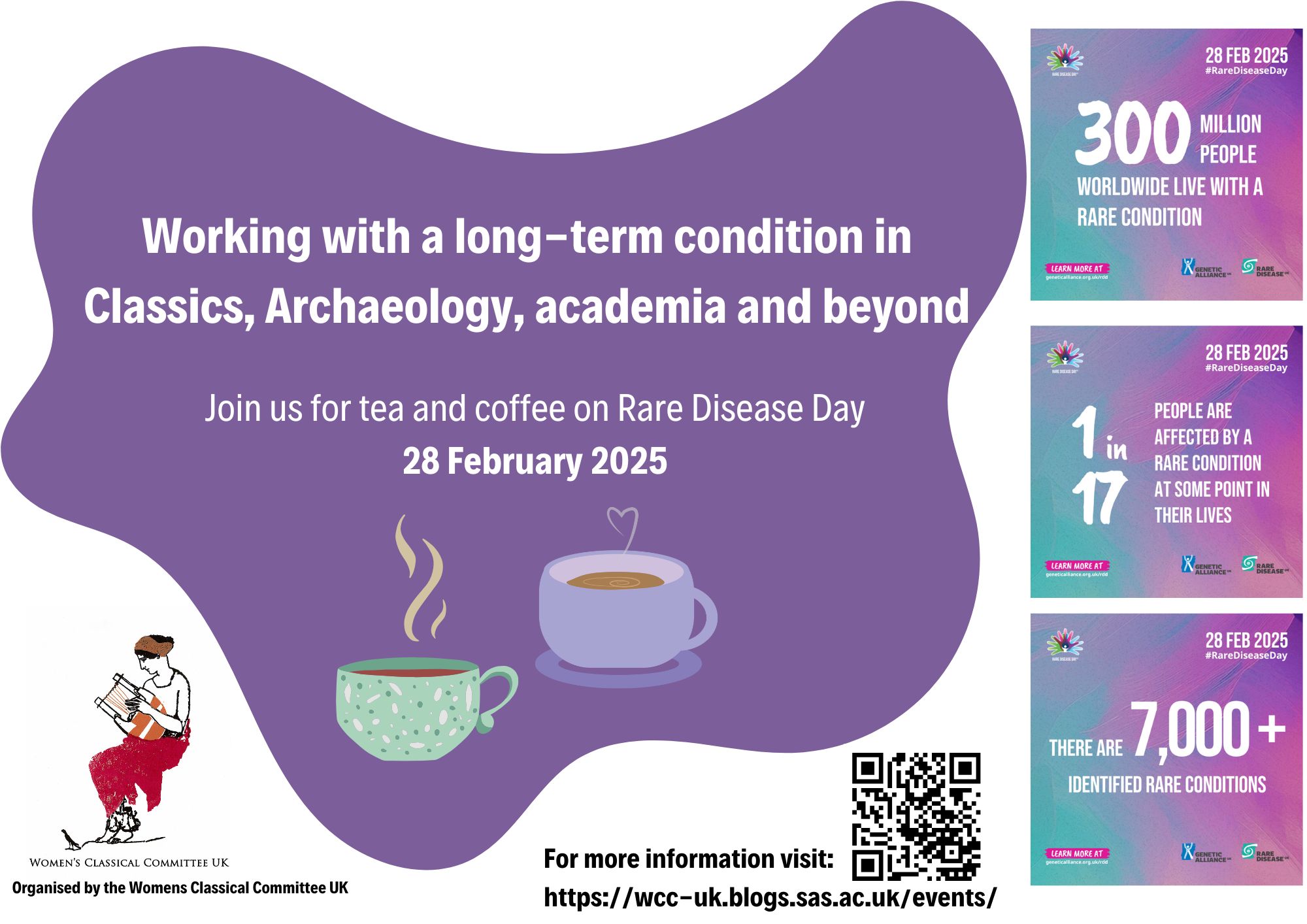
The WCC UK is delighted to host its second online networking event on ‘Working with a long-term condition in Classics, Archaeology, academia and beyond’.
The event will take place on 28 February 2025, at 15.00 – 16.00 (GMT).
Join us for tea and coffee in another networking event on this year’s ‘Rare Disease Day’
Programme
15.00 – 15.05: Welcome
15.05 – 15.15: Katerina Velentza (University of Hull)
15.15 – 15.25: Stephanie Dennie (University of Alberta)
15.25 – 15.40: Sharing challenges
15.40 – 15.55: Sharing achievements
15.55 – 16.00: Additional discussion
This networking event is seen as a safe space for people living with LTCs to share their experiences, concerns, and successes. But everyone is welcome, and we would love to have people who would simply want to raise awareness on ‘Rare Disease Day’ and learn more about how to best support individuals living with long-term conditions.
To register, please use the linked form.
by laurencet
The Women’s Classical Committee UK is pleased to announce its 2023 Annual General Meeting, ‘Labour and Rest‘, on Friday 3th May 2024. The AGM will be held in a hybrid format: please visit the TicketSource website. If you select to attend via Zoom, you will receive details closer to the date.
People of any gender expression or identity who support the WCC UK’s aims are welcome to attend this event. Further details are available here. Around the website you can also find more information on the Women’s Classical Committee UK, including our aims and activities and how to join.
The event will be a hybrid, in person and over Zoom. The event will be held at Durham University.
10:15: Welcome and housekeeping
10.30: Business meeting
11:30: Coffee break in local coffee shop or at home
12:00: Spotlight talks
13:15: Lunch (Akursu Turkish Restaurant)
14:30: Keynote: Professor Edith Hall (Durham): “Behind every working woman is an enormous pile of unwashed laundry”: A Cultural History of Dirty Clothes
15:30: Get to know the WCC – discussion on further directions (LT)
15:50: Wrap up and close
by laurencet
By Cora Beth Fraser, WCC UK Co-Chair and working-class classicist
The Women’s Classical Committee UK welcomes the report today on Class in Classics, compiled by the Network for Working-Class Classicists and supported by the Classical Association and the EDI Committee of the Council of University Classics Departments.
The report draws attention to an issue which we have all been aware of in Classics: that working-class people are underrepresented in the discipline, from undergraduate study through to professional employment. We have always known this – but thanks to the large-scale survey conducted by the Network for Working-Class Classicists and analysed in the Class in Classics Report, for the first time we can see the scale and impact of the imbalance. The report also helps to illuminate how working-class underrepresentation intersects with other characteristics to produce even greater imbalances for particular groups – one of which is working-class women, who are at a ‘double disadvantage’ (p.22 of the report).
The Class in Classics report gives us at the WCC UK a useful lens through which to view our own initiatives. It highlights the areas in which we are ahead of the discipline as a whole in modelling inclusive practice, and it also points out areas where we should develop our activism further in the future, in order to benefit working-class women and non-binary people in Classics.
Financial support
The Class in Classics report authors offer a number of practical recommendations for addressing elements of socio-economic disadvantage. Many of these recommendations endorse (explicitly or otherwise) the existing procedures and policies of the WCC in relation to financial support.
Our Small Grants Scheme, offering grants of up to £150 to members, makes payment upon approval of the grant, in line with the report’s recommendation to ‘avoid reimbursement systems whenever possible’ (p.52). The WCC recognises that reimbursement culture is inherently discriminatory, accessible only to the people who can afford to pay up-front costs, and acting as a barrier to those most in need of financial assistance.
The report (p.52) also references WCC good practice in naming the Small Grants Scheme:
The report (p.52) recommends careful phrasing on grant application forms, to avoid off-putting language or the implication that applicants have to prove their poverty:
‘Hardship funds should be renamed. “Hardship” can be a stigmatising term and it can also deter potential applicants if they believe they are not experiencing sufficient hardship. Consider borrowing phrasing from Sportula Europe (‘microgrants’) or the Women’s Classical Committee (‘small grants’).’
‘Similarly, revise policies that require applicants to demonstrate extreme poverty and/or exhaustion of commercial credit schemes before being considered for funding.’
At the WCC, our Small Grants application process requires applicants to explain the purpose of their application, the nature of the event or activity and how the grant will be spent; but there is no requirement for the applicant to plead poverty or divulge details of their financial circumstances.
Access
The Class in Classics report (p.50) draws attention to inequality of access, particularly to conferences and similar events, and the impact of that on belonging, networking and professional development.
‘Online or hybrid conferences improved accessibility, particularly for those with disabilities or caring responsibilities; but there is a concern that this mode of attendance is already being phased out, and that it does not provide adequate networking opportunities.’
The WCC has been very aware that online and hybrid access to events continues to be important, particularly for women who might have caring responsibilities. Our events continue to be either wholly online or hybrid, and there are no plans to remove that access option.
Access for those with caring responsibilities has been an issue of concern to the WCC for some time. In 2020 the WCC’s Caring in Classics Network published a set of guidelines for Supporting Carers and Organising Events, designed for the use of anyone organising either in-person or online events. In these guidelines we stated:
‘The provision of support for those with caring responsibilities is a central strategy for ensuring gender diversity, not only in practical provision that helps to get women in the room, but in empowering those who are not white, male, middle-class and able-bodied to feel that they are included and that they can productively contribute to the scholarly conversation.’
We welcome the renewed attention that the Class in Classics report will bring to the issue of support for access, which continues to be a key issue for the WCC.
Speaking out
The Class in Classics report (p.29) makes the point that it is difficult to talk about class:
‘Class has become such a difficult subject to broach that even in this anonymous survey there were concerns about saying the wrong thing.’
This is an important factor to emphasise, and perhaps suggests a need for a cautious approach to visibility, despite the report’s call for more working-class role models. It is difficult to speak out, and it also carries professional risks, because as many of the comments featured in the report highlight, people who talk about class in university Classics departments are often seen as disruptive or treated as outsiders.
In counterpoint to the report’s call for greater public visibility, the WCC recently lent its support to a confidential ‘safe space’ trial group for working-class women in Classics. Chaired by Dr Elizabeth Pender, Class Acts ran from 2021 to 2023 in the North of England, trialling co-operative peer support among a small group of working-class classicists with similar backgrounds. Its focus on individual and regional working-class experiences was designed to respond organically to the needs of participants. The Class Acts trial is currently being evaluated, with a view to embedding future versions of the group within existing WCC initiatives.
Conclusion
The Class in Classics report recommends a number of support strategies which the WCC UK put in place some years ago. We would like to see these becoming universal standards, reaching not just those classicists who have discovered the WCC, but everyone who comes into Classics.
Class is an uncomfortable topic for us to talk about in the UK, but the remarkable number of responses to the Class in Classics Survey (1,206) suggests that there is a real need to open up the discussion in Classics. At the WCC we look forward to playing a part in these essential conversations.
by laurencet
Online Workshop
29 February 2024 (‘Rare Disease Day’), at 16.00 – 17.15 (GMT)
This ‘Rare Disease Day’ we would like to invite you to the online workshop ‘Working in Archaeology, Heritage and Classics with a Long-Term Condition’.
A long-term condition (LTC) is defined as a condition that cannot, at present, be cured but is controlled by medication and/or other treatment/therapies.
Some examples include:
LTCs have a large impact on a person’s life. Therefore, individuals require ongoing care and support.
In this workshop three speakers will present their experiences of living with LTCs and working in archaeology, heritage and Classics. Subsequently, there will be a discussion where participants will have the opportunity to share their own experiences and problems, but also ask questions to the group.
The workshop is meant to be a safe space for people living with LTCs to share their experiences, concerns, and successes, but also for people who would simply want to learn more about how to best support individuals with LTCs in the archaeology, heritage and Classics sector.
From this event we hope to create an informal support group that people with LTCs can turn to for advice or simply sharing experiences and issues related to LTCs and their working life.
Programme
16.00-16.15: Introduction by Katerina Velentza (WCC UK Disability Liaison)
16.15-16.30: Alexandra F. Morris (University of Lincoln & University of Nottingham)
16.30-16.45: Amanda Hart (Roman Baths and Pump Room)
16.45-17.15: Discussion
Register for the online workshop here: https://helsinki.zoom.us/meeting/register/u5YufuutqD8uG9PkF35DnepHlHw8RmVoZU0H


by laurencet
| The Women’s Classical Committee UK is organising an event aimed at mid-career scholars, to be held on Friday 19th January 2024 on Zoom between 10am and 1pm. We are delighted that Dr Ellen Adams, King’s College London, will be our keynote speaker. The Women’s Classical Committee UK run a mid-career event annually to help colleagues discuss the issues and challenges that face academics, particularly women, at mid-career. Topics to be discussed may include decisions about whether and when to move institutions, questions around disciplinarity/interdisciplinarity and collaboration in research, expectations about international mobility and balancing this with family/caring duties, managing institutional expectations (which may be gendered) around types and levels of administrative service, taking on leadership positions, ways of supporting precarious colleagues, and strategies to tackle unconscious bias in the workplace. Those who register their intent to attend will be invited to fill in an online questionnaire, the results of which will inform the precise choice of topics for discussion sessions. We envisage that the day’s discussions will help to set priorities for resource development and future campaigns by the Women’s Classical Committee UK. The WCC UK recognises that the term ‘mid-career’ is open to a range of interpretations, but also that different challenges face women in classics in different situations and career stages. This event is aimed primarily at women who self-define as having reached mid-career; markers of this may include being eight or more years after the award of their PhD, holding an open-ended contract, and having an established publication profile. If the event is oversubscribed then we will give priority to women in this situation, but we welcome applications to register from anyone of any gender who feels they would benefit from attending. Registration Options The event is capped at 15 attendees; we will be prioritising WCC UK members and non-members based in the UK should this event be oversubscribed. Free registration is available to all via Ticket Source; if the event reaches capacity, WCC UK members will be given priority. Donations in support of the WCC UK and its activities are welcome. Child-friendly policy The Women’s Classical Committee is committed to making our events as inclusive as possible, and recognises that the financial and practical challenges of childcare often impede people from participating in workshops and conferences. We welcome the virtual attendance of children at this event. |